3 Reasons You Need a Bottle Sterilizer and Dryer

This post may contain affiliate links. Read our policy.
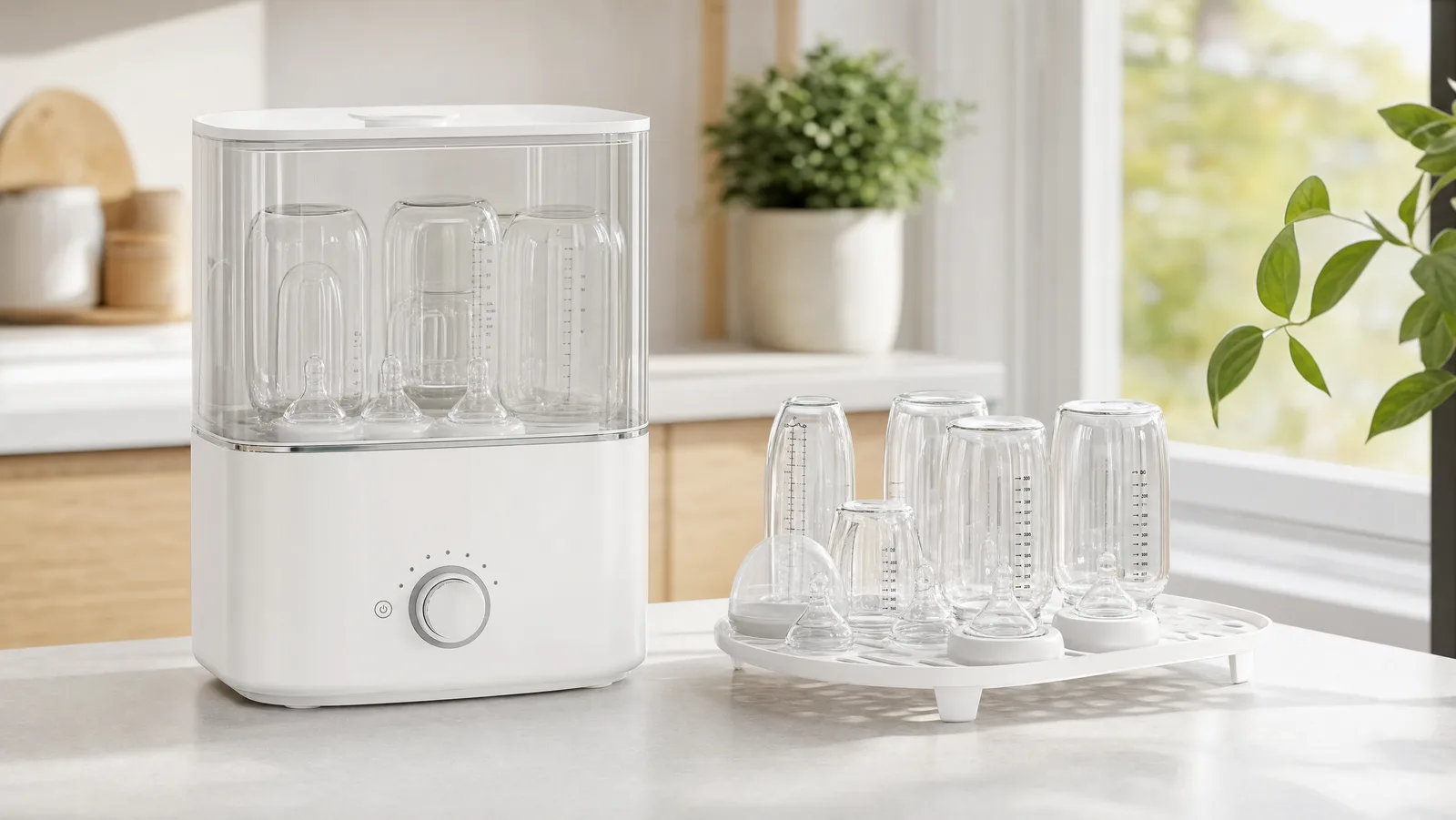
If you've ever stood at the kitchen sink at 2 a.m., squinting at a drying rack full of bottles you cleaned six hours ago and wondering whether they're actually clean or just decoratively damp, this one's for you. Bottle-feeding a newborn means an endless cycle of washing, and somewhere around week three most of us start asking the same question: is there a machine that just handles this? There is. A bottle sterilizer and dryer takes the guesswork — and a surprising amount of the labor — out of keeping feeding gear safe.
Here's the honest version: you don't strictly need a sterilizer to raise a healthy baby. But there are a few very good reasons it earns its counter space, and once you understand what these machines do well, picking the right one gets a lot easier.
Reason 1: It kills the germs that matter to a brand-new immune system
A newborn's immune system is still under construction, which is exactly why the early weeks call for extra care with feeding gear. The CDC recommends sanitizing infant feeding items at least once a day, and that guidance is strongest for babies under two months, infants born prematurely, and any baby with a weakened immune system. Unwashed or poorly cleaned bottles can harbor common bacteria, so that daily deep clean is a real safeguard while your little one's defenses ramp up.
Electric steam sterilizers handle this by heating water to boiling and bathing every bottle, nipple, and ring in hot vapor. Because the steam fills the whole chamber, it reaches surfaces a quick hand-wash can miss. Most steam models are built to kill 99.9% of common household germs in a single short cycle — our top all-rounder, the Papablic Baby Bottle Sterilizer & Dryer Pro, runs about eight minutes of steam before it moves on to drying, and it keeps everything sterile for up to 24 hours as long as you leave the lid shut.
If germ protection is your top concern, a sterilizer pairs naturally with smart bottle choices. We're partial to glass for exactly this reason — it's nonporous and stands up to repeated high-heat cycles without scratching the way some plastics do. If you're still building your feeding kit, our roundup of the best glass baby bottle brands walks through which ones we'd buy again.
Reason 2: It saves you real time (goodbye, boiling pot)
The old-school method — submerging bottles in a pot of boiling water — works, but it's a chore. You have to watch the stove, fish hot bottles out with tongs, and you can only do a few at a time. An electric sterilizer is genuinely hands-off: load it, press a button, walk away.
That convenience compounds when you're running a lot of bottles — and if you're not sure how many that'll be, our formula feeding calculator estimates the daily ounces and number of bottles from your baby's weight. The GROWNSY Compact Bottle Sterilizer & Dryer packs a full 4-in-1 routine — sterilize, dry, both, or store — into a footprint small enough for a cramped apartment counter, with an 8-minute steam cycle to kill 99.9% of bacteria. For bigger households, the WONDBORN Bottle Sterilizer & Dryer holds up to 12 bottles and offers a 6-minute quick cycle or a deeper roughly hour-long run rated up to 99.999% — a lifesaver if you're feeding twins or just tired of doing two loads a night.
Budget matters too, and you don't have to spend a fortune to get the time savings. The MOMFANN All-in-One Steam Sterilizer & Dryer sterilizes in about 8 to 15 minutes, dries in roughly 20 to 60, shows an LED countdown so you're not guessing, and even doubles as a gentle food warmer — a lot of flexibility for a first machine that won't break the bank.
Reason 3: It dries bottles hygienically — no contaminated drying rack
This is the reason people underestimate. A bottle isn't truly ready until it's dry, and the standard open-air drying rack is a problem: bottles sit damp for hours on a surface that collects airborne dust, kitchen splatter, and bacteria. You can sterilize a bottle perfectly and then quietly recontaminate it on the way to dry.
A combo sterilizer-dryer closes that gap by finishing the bottles with warm, often filtered air inside the sealed chamber. The Papablic Pro spends most of its 36-minute cycle drying after the steam phase, so bottles come out genuinely ready to use. Several models go further on air quality — the WONDBORN uses HEPA-filtered drying air, and the GROWNSY has a built-in filter — which is a nice touch if anyone in your home has allergies.
A different approach: UV-C cabinets
Not every sterilizer uses steam. The Wabi Baby UVC LED Sanitizer & Dryer Ultra is a premium UV-C cabinet that uses nine OSRAM 275nm LEDs to damage germs' DNA instead of boiling water — so there's no scale to descale and no waiting for water to heat. It's FDA-registered and ETL-certified, dries at a plastic-safe 104°F, auto re-sanitizes every three hours, and its roomy 25-liter, mercury-free cabinet holds 16+ bottles plus pump parts and pacifiers.
A fair, honest note on UV: because UV-C only sterilizes the surfaces the light actually reaches, how you load the cabinet matters more than with steam, where vapor fills every nook. Some bottle makers also caution that UV-C can degrade certain plastics over time. Enclosed cabinet-style units like this one are considered safe when used as directed — it's handheld UV wands the FDA warns about, not sealed appliances.
What to look for in a bottle sterilizer and dryer
A few decision factors will steer you to the right machine faster than any spec sheet:
Capacity vs. counter space
Be honest about both your kitchen and your bottle rotation. A compact unit like the GROWNSY is perfect for small spaces and one baby, while a 12-bottle WONDBORN makes sense for twins or families who batch a full day at once.
Does it dry, or just sterilize?
This is the big one. A sterilize-only unit still leaves you with the drying-rack problem. Every pick here dries as well, which is the whole point.
Steam or UV
Steam is fast, thorough, and budget-friendly but needs occasional descaling. UV is convenient and water-free but depends on careful loading and can be gentler on bottles to skip if a brand advises against it. Both kill the same everyday germs.
Fit and material safety
Check that your bottle brand fits — the Papablic, for instance, is sized for Avent and Dr. Brown's. Look for non-toxic contact materials too, like the Papablic's CeraCare ceramic plate, especially since these surfaces touch gear that goes in your baby's mouth.
Cycle time and ease of use
At 4 a.m., one-button operation and a visible countdown (like the MOMFANN's LED) matter more than you'd think. Faster quick-cycles are great for mid-day resets; longer deep cycles are reassuring for that first sterilize of brand-new gear.
A clean bottle is part of a bigger safety picture
A sterilizer is one piece of a safe, healthy nursery — and once you've got feeding handled, it's worth thinking ahead. As your baby starts moving, our guide to keeping your child safe with a baby gate covers the next big safety upgrade, and on the not-fun-but-essential side, having the right thermometer on hand makes those first fevers a lot less frightening.
The bottom line
You can absolutely raise a healthy baby with a pot of boiling water and a clean towel — parents have for generations. But a good sterilizer and dryer buys back time you don't have, kills the germs that matter most while your newborn's immune system is still developing, and finishes the job by drying bottles hygienically instead of leaving them on a questionable rack. For most families, the Papablic Pro hits the sweet spot of capacity, drying, and value, but there's a pick above for every kitchen and budget. Whichever you choose, your future 2 a.m. self will thank you.
One last note on money, since a sterilizer is a one-time buy: the costs that actually compound in year one are the consumables. Our diaper cost calculator projects that running total from your pack price and your baby's age, which is a more useful number to budget against than any single appliance.

Papablic Baby Bottle Sterilizer & Dryer Pro
An electric steam sterilizer and dryer that runs a full sterilize-and-dry cycle in about 36 minutes (roughly 8 minutes of steam plus 28 minutes of drying). It holds up to 10 bottles and uses a CeraCare non-toxic ceramic heating plate, and it's roomy enough for popular bottles like Avent and Dr. Brown's. Once a cycle finishes, contents stay sterile for up to 24 hours if you keep the lid closed.
- Brand
- Papablic
- Category
- Our Pick
I load it before bed, hit start, and wake up to a full set of dry, ready-to-use bottles — no soggy drying rack on my counter anymore.

GROWNSY Compact Bottle Sterilizer & Dryer
A space-saving electric steam sterilizer and dryer built for smaller kitchens. Its 8-minute steam cycle is designed to kill 99.9% of common bacteria, and a built-in filter helps keep drying air clean. The 4-in-1 design lets you sterilize, dry, do both in one pass, or just store, and it fits most bottle brands.
- Brand
- GROWNSY
- Category
- Best Compact
It barely takes up any counter space, which was a dealbreaker for our tiny apartment, and the one-button cycles couldn't be easier on three hours of sleep.

WONDBORN Bottle Sterilizer & Dryer (12 Bottles, HEPA)
A high-capacity steam sterilizer and dryer that holds up to 12 bottles, making it a strong pick for twins or heavy bottle rotations. It offers a 6-minute quick cycle or a roughly 60-minute deep cycle rated up to 99.999%, plus HEPA-filtered drying air and three dryer settings. A 72-hour storage mode keeps clean bottles ready, and it runs on standard 120V.
- Brand
- WONDBORN
- Category
- Best Large Capacity
With twins we go through a mountain of bottles, and being able to do a full dozen at once finally got us off the boil-and-pray routine.

MOMFANN All-in-One Steam Sterilizer & Dryer
An affordable all-in-one steam sterilizer and dryer that sterilizes in about 8 to 15 minutes and dries in roughly 20 to 60 minutes, with an LED countdown so you always know where the cycle is. It holds up to 8 bottles and can also gently warm or thaw food, making it a flexible first machine for new parents on a budget.
- Brand
- MOMFANN
- Category
- Best Budget
It does everything our pricier friends' machines do for a fraction of the cost, and the little countdown screen is weirdly reassuring at 4 a.m.

Wabi Baby UVC LED Sanitizer & Dryer Ultra
A premium UV-C LED sanitizing and drying cabinet that uses nine OSRAM 275nm UV-C LEDs instead of steam, so there's no boiling water or scale to manage. It's FDA-registered and ETL-certified, dries at a plastic-safe 104°F, and auto re-sanitizes every 3 hours to keep contents fresh. The 25-liter, mercury-free cabinet swallows 16+ bottles plus pump parts and accessories.
- Brand
- Wabi Baby
- Category
- Premium Pick
It's a splurge, but it doubles as gorgeous countertop storage for everything — bottles, pump parts, pacifiers — and I never worry about descaling it.
- 01PapablicOur PickPapablic Baby Bottle Sterilizer & Dryer Pro
- 02GROWNSYBest CompactGROWNSY Compact Bottle Sterilizer & Dryer
- 03WONDBORNBest Large CapacityWONDBORN Bottle Sterilizer & Dryer (12 Bottles, HEPA)
- 04MOMFANNBest BudgetMOMFANN All-in-One Steam Sterilizer & Dryer
- 05Wabi BabyPremium PickWabi Baby UVC LED Sanitizer & Dryer Ultra
Do I really need to sterilize baby bottles, or is washing enough?+
How often should I sterilize my baby's bottles?+
When can I stop sterilizing bottles altogether?+
Is a UV sterilizer or a steam sterilizer better?+
How long do bottles stay sterile after a cycle?+
Do I still need a separate dryer, or does the sterilizer handle it?+
Sammie Seelbach
Sammie is a mom of two and the lead reviewer at Smart Baby Reviews. Since becoming a parent she has become obsessed with researching the safest, smartest baby gear on the market — testing thermometers at 2 a.m., wrangling baby gates, and sterilizing more bottles than she can count. She shares what actually works so other parents can make confident, informed decisions for their little ones.