When to Start Baby-Proofing (and What to Tackle First)

This post may contain affiliate links. Read our policy.
When should you start baby-proofing? Before your baby can move, not after. Baby-proof for the milestone your baby is about to hit rather than the one they are on, which in practice means the big jobs happen during pregnancy or the newborn weeks and everything else arrives a stage early. Some of the links below are affiliate links, and we may earn a small commission, at no extra cost to you, if you buy through them.
Here is the moment that taught me. I put my daughter down on a blanket in the middle of the living room, went to the kitchen to top up my coffee, and came back ninety seconds later to find her three feet away under the side table, thrilled with herself, holding a lamp cord. She had never rolled before. No warning, no practice round. There was a baby who could not move, and then there was a baby who could.
That gap, between the day you expect a new skill and the day it shows up, is where nearly every baby-proofing regret lives. So here is the timeline I use now: what each stage newly puts in reach, what to do before your baby moves at all, and what can honestly wait. The full room-by-room version of baby-proofing your home is a separate walk-through. This one is about the order.
When to Start Baby-Proofing: Before the Milestone, Not After
The American Academy of Pediatrics' childproofing advice is to take extra steps to get harmful items out of reach and out of sight "before or as soon as your child begins crawling or walking." Note the "before." The AAP's 6-to-12-month safety guidance is blunter about why: your child "will suddenly be able to roll over, crawl, sit, and stand," may climb before walking, and, in the line that has stuck with me for years, "often, injuries happen because parents are not aware of what their children can do."
That is the whole argument. You are not preparing for the baby in front of you. You are preparing for the one who shows up in three weeks.
Before you buy a single thing, know that the highest-value early jobs cost nothing. Moving the crib away from the window. Turning the water heater down. Putting the medications on a high shelf instead of in the bathroom cabinet. Getting on the floor and looking. None of that is a purchase, and all of it outranks any product on this page.
The Baby-Proofing Timeline, Stage by Stage
One note on the ages below. They come from the CDC's developmental milestone checklists, revised in 2022 and framed as things most children, meaning 75% or more, can do by a given age. They are not a schedule your baby is supposed to keep. Babies vary enormously and plenty reach these in a different order, so anything that worries you about your own child's development belongs with your pediatrician. Here, milestones are only a trigger for house projects.
Pregnancy and the newborn weeks. Nothing your baby can do yet, which is exactly why this is the most productive stretch you will get. The full list is in the next section, and it is short: anchor the furniture, sort out where the crib sits, turn down the water heater. If you are still counting down, our pregnancy due date calculator gives you the week you are in, which is the number these jobs are really scheduled against.
Rolling, by around six months. The CDC lists rolling from tummy to back among the things most babies do by six months. What that puts in reach is a radius, not a room. Wherever you set your baby down, everything within a body length of that spot is now fair game, and no raised surface, changing table included, can be left unattended for a second.
Sitting, by around nine months. By nine months the CDC lists sitting without support and getting into a sitting position independently. Sitting changes the geometry: hands come up off the floor and out in front, which brings the top of a low table, the contents of a bottom shelf, and every small object under the couch into play. Sweep the floor for choking hazards, and cover the sockets they can actually reach.
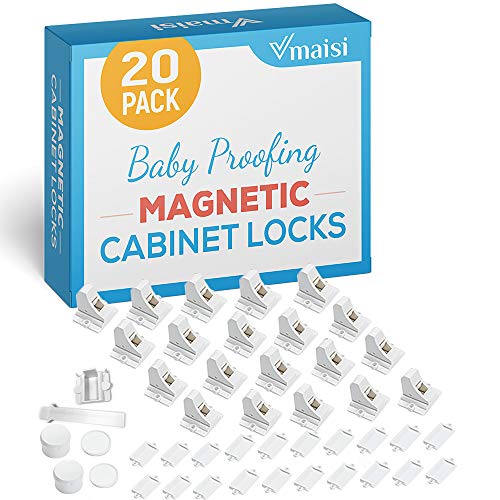
Crawling, which the CDC no longer lists at all. Crawling was dropped from the checklists in the 2022 revision, and as reporting on the change explained, the reason was thin normative data on when most children crawl, and some babies skip it — not that crawling does not matter. Plenty of babies scoot, roll or shuffle, and some go straight from sitting to pulling up. So do not use crawling as your trigger, because for some babies it never comes. Whenever floor-level travel starts, every low cupboard becomes a door, which is where a set of cabinet and drawer locks earns its keep. Magnetic ones like the Vmaisi 20-pack hide inside the door, though test the position first, since metal inside a cabinet door can throw the magnet off.
Pulling up and cruising, by around twelve months. The CDC's one-year list includes pulling up to stand and walking while holding on to furniture. Two things change at once. Your baby's reach jumps to standing height, taking in table edges, countertop overhangs, tablecloths and anything left on a low surface, and the furniture itself becomes climbing equipment. This is when edge and corner guards start earning their money, and when the kitchen stops being a room you pass through and starts needing its own dedicated pass.
Walking, first steps by around fifteen months. The CDC lists taking a few steps alone by fifteen months and walking without holding on to anything by eighteen. Walking collapses your house into one room. A child who can cross a hallway and reach a handle now decides which rooms they are in, so this is where doors, knobs and locks matter more than any latch, especially the garage, the bathroom and any door to the outside.
Climbing, by around eighteen months. The CDC's eighteen-month list includes climbing on and off a couch or chair without help. Height becomes a variable, and half your earlier work quietly stops being enough. More on that below.
What to Do Before Your Baby Moves at All
This is the pre-mobile list, and it is the most important part of the page. All of it is doable during pregnancy or the newborn fog, and none of it depends on what your baby can do.
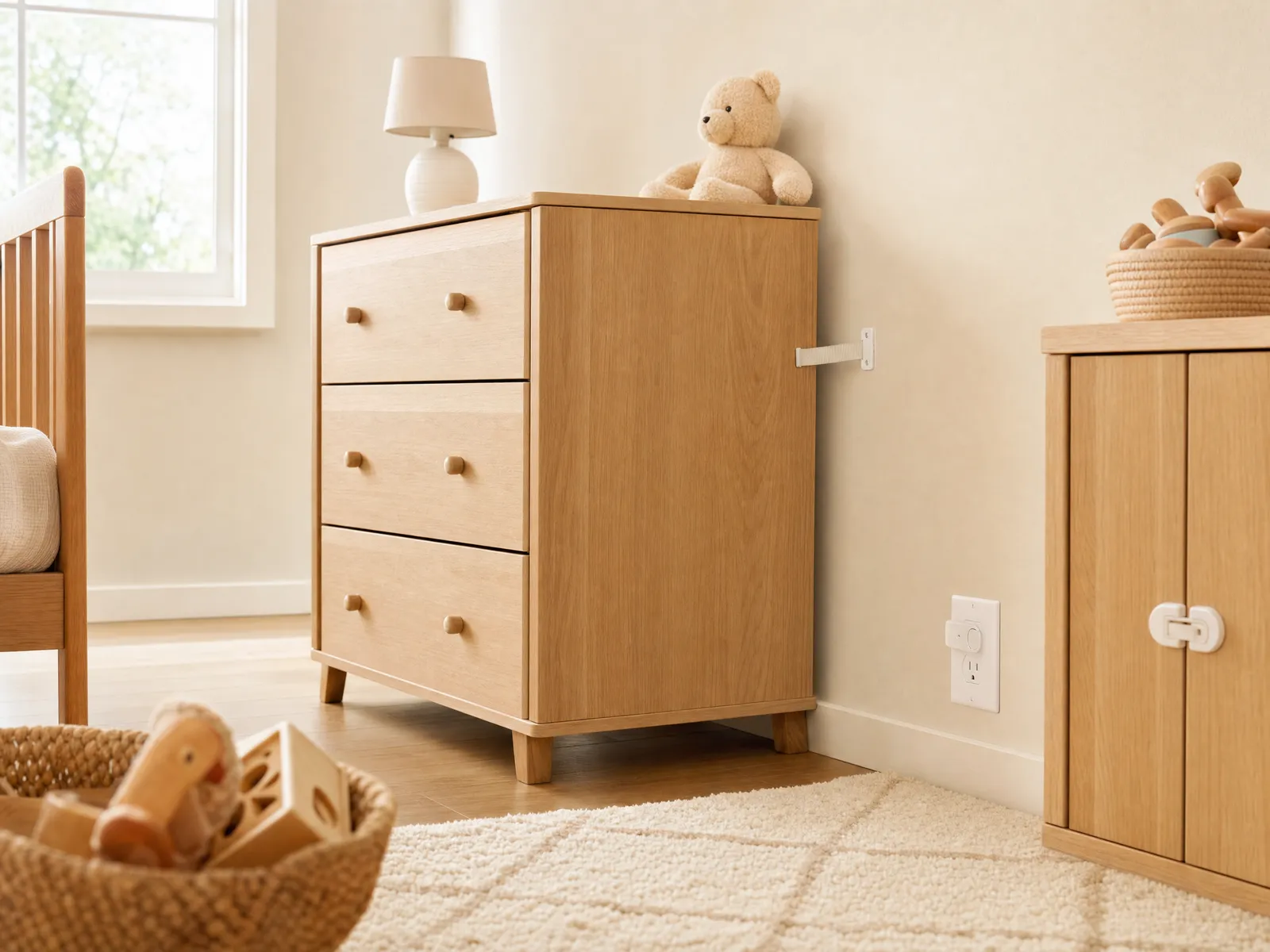
Anchor the furniture. According to the Consumer Product Safety Commission, about 17,800 people a year are injured in furniture, TV and appliance tip-over incidents, children under 18 account for 44% of those injuries, which works out to a child treated in an emergency department every 53 minutes, and children make up 71% of the deaths. Under the STURDY Act rule, newly manufactured clothing storage furniture has had to meet updated stability criteria since September 1, 2023, which does nothing for the dresser already in your bedroom. A pack of furniture anchors and an evening with a stud finder is the highest-return hour on this page.
Fix where the crib sits. The AAP's guidance on choosing a crib says to place it away from windows and to make sure there are no strings from blinds or curtains close by that could wrap around your baby's neck. This is the clearest example of the whole thesis: the risk is real while your baby is completely stationary, because it is about where the crib is, not about what the baby can do. The CPSC reports that on average about nine children under five die each year from strangling in the cords of blinds, shades and draperies, which is why cords and blind safety is a month-one job rather than a month-nine one.
Turn the water heater down. The AAP recommends setting your water heater so the hottest temperature at the faucet is no more than 120 degrees Fahrenheit, about 49 Celsius. Ten minutes, no cost, smaller utility bill.
Get the safe-sleep basics right. The AAP's safe sleep guidance is that babies sleep on their backs, alone, on a firm flat non-inclined surface, with no soft bedding, pillows, bumpers or toys in the sleep space. Not hardware, but it belongs on the same pre-birth list.
The Free Test That Finds More Than Any Kit
Get down on the floor in each room and look around at your baby's eye level. Not a glance from the doorway, an actual minute on your hands and knees.
The first time I did this in our living room I found four things in ninety seconds that I would have sworn were not there: a wobbly floor lamp, a low outlet behind the couch, a dangling blind cord, the sharp stone corner of the hearth. From standing, none of it registers. From ten inches off the carpet, it is all you can see.
Repeat it once per stage, because the view changes. What a roller can reach is nothing like what a cruiser can pull down on themselves.
If You Have One Weekend and a Small Budget
Work in this order, which is roughly how badly things go wrong rather than how easy they are.
- Anchor every tall or top-heavy piece of furniture, plus the TV. Per the CPSC figures above, this is among the most serious preventable home hazards.
- Move medications and cleaning products up high, not just behind a latch. Poison Control reports that the peak frequency of unintentional poisoning is among one- and two-year-olds, and the AAP's phrase is out of reach and out of sight, which a high shelf manages and a low latch does not.
- Deal with looped blind cords, and move the crib and any climbable furniture away from windows.
- Gate the stairs, hardware-mounted at the top, no exceptions.
- Then the volume work: cabinet latches, outlet covers, knob covers. An 80-piece starter kit saves you six separate orders and a week of waiting.
If you only get through the first three, you have done the part that matters most. The rest is genuinely a next-weekend job.
What You Can Genuinely Put Off
Not everything needs doing at once, and pretending otherwise is how people quit halfway.
Corner and edge guards can wait until your baby is pulling up, because a coffee table edge is not a hazard to someone who cannot get near it. Stove knob covers can wait until your child can reach the knobs, and toilet locks until they can stand and lift the lid. Rooms your baby never enters can stay unproofed behind a closed door, and a closed door is a perfectly respectable safety device.
The list that cannot wait is short: anchors, poisons, cords, stairs, water temperature.
The Second Wave: Why Eighteen Months Undoes Half Your Work
Nobody warns you about this part. You finish baby-proofing, you exhale, and then your toddler learns to climb and half your work quietly expires.
The CDC's eighteen-month checklist includes climbing on and off a couch or chair without help, and once that arrives the whole house has a second storey. A dining chair becomes a ladder to the counter. An open drawer becomes a step to the top of the dresser, which is exactly the failure mode furniture anchors exist to prevent. Latches that stumped a ten-month-old get solved by a determined twenty-month-old who has watched you open them two hundred times.
So re-run the floor test from the height of every climbable surface rather than from the carpet, and retire the stair gates once your child can climb them — Nationwide Children's Hospital suggests around age two, since children can fall climbing a gate.
The Jobs That Are Never Finished
A few things never come off the list, however much hardware you install.
Supervision is the first, and no device replaces it. Every latch, gate and anchor exists to buy you the fifteen seconds it takes to turn around and stir a pot, not to let you leave the room. Water is the second: bathtubs, buckets, toilets and paddling pools stay dangerous long after the rest of the house has calmed down. And the Poison Help number, 1-800-222-1222, belongs in your phone and on the fridge before you need it.
Then set a recurring reminder to walk the house again every few months. A room that was perfectly safe for a roller is a brand-new adventure for a climber.
Start Where Your Baby Is Headed
If you take one thing from this page, take the timing rule: work one milestone ahead. Anchor the furniture before there is anyone to pull on it. Put the corner guards on when the pulling-up starts, not after the first goose egg.
The reassuring half is real too. You do not have to do all of it, and certainly not in one weekend. There is an order, most of the top of that order is free, and the rest can arrive one delivery at a time. When you want the full room-by-room version, how to baby-proof your home walks through the whole house in the same calm order.
Start this week with the floor test and one pack of anchors. That is a good evening's work, and it is the part your future self will thank you for. You've got this.

Booda Brand Metal Furniture Anchors, 10 Pack
Stainless steel straps that hold a dresser, bookcase, wardrobe or TV stand to the wall, which is the one job genuinely worth finishing before your baby can move at all. The 10-pack ships with screws, steel wire straps, brackets and expansion nails, and Booda Brand states that two sets on a single piece of furniture can withstand a load of up to 400 lbs. The screw-closure design detaches, so you can release a strap to clean behind the dresser and reconnect it without redoing the install.
- Brand
- Booda Brand
- Category
- Do This First
We anchored every tall thing in the house on a Sunday afternoon while I was still pregnant, and it is the only baby-proofing I have never once had to think about again.
Vmaisi Magnetic Cabinet Locks, 20 Pack with 2 Keys
Twenty locks and two magnetic keys, sized for the stage where your baby gets down on the floor and discovers that cupboards open. They mount inside the cabinet with 3M adhesive, so there is no drilling and nothing shows from the outside, and they fit cabinet doors up to 2 in thick. One caveat worth knowing before you peel the backing off: metal hidden inside a door, such as screws, nails or staples, can interfere with the magnet, so test the position with the door closed before you stick a lock down for good.
- Brand
- vmaisi
- Category
- Best for the Crawling Stage
Our daughter went from sitting up to opening the under-sink cupboard in about a week, and these went in the same night we noticed.

HomeBrella Self-Closing Sliding Outlet Covers, 4 Pack
A wall plate that replaces the one already on your outlet, with a sliding cover that blocks the socket holes so fingers and objects cannot go in. It is self-closing, so the cover slides back on its own the moment you unplug a cord and there is nothing for a tired parent to remember. It fits both Decorator two-screw and standard single-screw outlets, and because the cover is part of the plate there is no small piece to lose or swallow the way there is with individual plug-in caps. Sold as a 4-pack, which covers the handful of sockets a new sitter can actually reach.
- Brand
- HomeBrella
- Category
- Best Quick Win
I stopped finding little plug caps in the sofa cushions, which honestly was reason enough to switch.

Roving Cove Slimfit Corner and Edge Protector, Small 15ft Edge plus 4 Corners, Oyster White
Fifteen feet of edge guard plus four corner protectors, which is enough for a standard coffee table, hearth or low shelf. This is a cruising-stage purchase rather than an early one, because a table edge only becomes a problem once your baby is pulling up along it. The foam is 0.3 in thick and 0.6 in deep NBR rubber at Shore A 20-N density, and Roving Cove makes the point that density matters more than thickness for absorbing an impact. The four corners arrive pre-taped, but budget a few extra minutes for the edge guard, which you attach with the 30 ft of 3M double-sided tape in the box.
- Brand
- Roving Cove
- Category
- Best for the Cruising Stage
We put these on the week she started cruising the coffee table, and the sound of a forehead meeting wood is one I have not heard since.

Safety 1st Home Safeguarding and Childproofing Set, 80 Pieces, White
Eighty pieces in one box, for the weekend where you want to do a whole first pass instead of placing six separate orders and waiting on all of them. It covers several rooms at once with 30 cabinet and drawer latches, 4 slide locks for double-door cabinets, and 6 Grip 'n Twist door knob covers for the rooms you would rather keep off limits. Treat it as the broad sweep, not the finish line, and buy the high-stakes items like anchors and stair gates separately.
- Brand
- Safety 1st
- Category
- Best All-at-Once Starter
One box took our whole downstairs from nothing to reasonably safe in an afternoon, latches and knob covers and all.
- 01Booda BrandDo This FirstBooda Brand Metal Furniture Anchors, 10 Pack
- 02vmaisiBest for the Crawling StageVmaisi Magnetic Cabinet Locks, 20 Pack with 2 Keys
- 03HomeBrellaBest Quick WinHomeBrella Self-Closing Sliding Outlet Covers, 4 Pack
- 04Roving CoveBest for the Cruising StageRoving Cove Slimfit Corner and Edge Protector, Small 15ft Edge plus 4 Corners, Oyster White
- 05Safety 1stBest All-at-Once StarterSafety 1st Home Safeguarding and Childproofing Set, 80 Pieces, White
What is the earliest I should start baby-proofing?+
Is it too late if my baby is already crawling?+
Do I have to baby-proof the whole house at once?+
How do I baby-proof a rental without drilling?+
What about grandparents' houses and other homes we visit?+
When can I take the baby-proofing down?+
Sammie Seelbach
Sammie is a mom of two and the lead reviewer at Smart Baby Reviews. Since becoming a parent she has become obsessed with researching the safest, smartest baby gear on the market — testing thermometers at 2 a.m., wrangling baby gates, and sterilizing more bottles than she can count. She shares what actually works so other parents can make confident, informed decisions for their little ones.