The Best Corner Guards and Edge Protectors for Babies

This post may contain affiliate links. Read our policy.
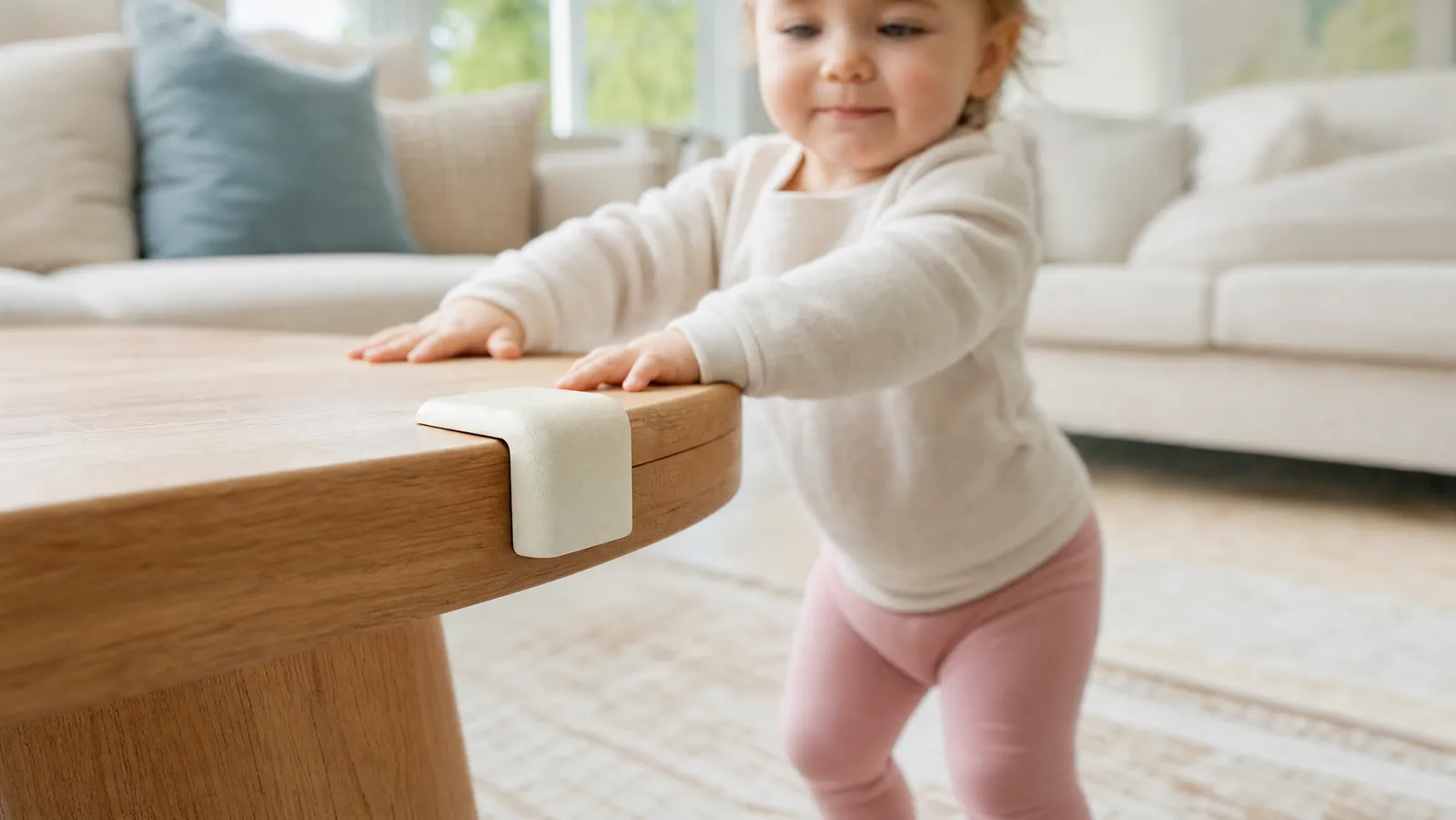
Our coffee table is white oak, square-cornered, and exactly the height of my daughter's temple. I owned it for four years without ever noticing that. Then she started pulling herself up on it — one hand, then two, then a wobble, then a grab at nothing — and I spent the next ten minutes sitting on the floor with my eyes level with that corner, doing math I did not enjoy.
That is the moment most of us go looking for this stuff. Some of the links below are affiliate links, and we may earn a small commission — at no extra cost to you — if you buy through them. The best baby proofing corner guards are the ones that stay stuck and match the furniture you already own, because a bumper that falls off on its own, or one you rip off in a month because you cannot stand looking at it, protects exactly nobody.
Padding sharp corners is a genuinely recommended step in how to baby-proof your home, and it is also one of the most oversold. So here is the honest version: what the safety agencies actually say, the four things that separate a guard that lasts from one you find under the couch, the five sets I would buy, and how to install them so they hold.
What the AAP and CPSC actually say about padding sharp corners
Short answer: both of them name it, and both of them name the coffee table.
The American Academy of Pediatrics tells parents to check for furniture with hard edges and sharp corners that could injure a child, and it flags coffee tables as a particular hazard. It then offers two paths: move the risky furniture out of high-traffic areas while your child is learning to walk, or buy cushioned corner and edge protectors that stick onto the furniture. Both count, and moving the table is free — do not skip past that option too quickly.
The Consumer Product Safety Commission includes corner and edge bumpers in its list of childproofing devices, to help prevent injuries from falls against sharp edges of furniture and fireplaces. It attaches one buying instruction that is worth underlining, because it is the entire review in seven words: look for bumpers that stay securely on furniture or hearth edges.
Hold on to that. "Stays securely" is why half this guide is about adhesive rather than foam.
As for why this lands so hard at this exact age — falls are the everyday hazard, not the exotic one. According to the federal America's Children report, which draws on CDC injury data, falls were the leading cause of injury-related emergency department visits among children ages 1 to 4 in 2021 and 2022 — 33 percent of those visits — at a rate of 45 visits per 1,000 children that age. A baby learning to cruise falls constantly. That is not a failure of parenting; it is the job description. All you are choosing is what she lands on.
Bumpers soften a bump. They do not stop a fall.
Here is the part the product listings will not tell you. A corner guard changes what your child hits. It does not change whether she falls, how often, or how hard, and it does absolutely nothing about the hazard that actually sends kids to the hospital with head injuries.
That hazard is the furniture coming down on top of them. The AAP is blunt about it: children can be seriously hurt or even killed when they climb onto, fall against or pull themselves up on large pieces of furniture like bookshelves and dressers, and its advice is to anchor bookcases, dressers and TV stands to the wall.
The scale is worth sitting with. A study from the Center for Injury Research and Policy at Nationwide Children's Hospital, using the CPSC's national injury surveillance data, estimated that 560,200 children under 18 were treated in US emergency departments for furniture or TV tip-over injuries between 1990 and 2019. In 2019 alone there were 11,521 injured children, an average of one every 46 minutes. Children under 6 accounted for 70 percent of those injuries, with a peak at age 2, and almost half of all injuries, 47 percent, were to the head or neck.
A strip of foam on the corner of a dresser does nothing about any of that. So if you only have one afternoon, anchor the dresser to the wall first and pad it second. Padding is for the hundred small bumps you are definitely going to get. Anchoring is for the one you cannot afford.
One more honest counterweight. A guard that a determined toddler works loose becomes a piece of foam in a mouth. I could not find a safety agency publishing a hard number on that risk, so I will not invent one — but notice that the CPSC's instruction is specifically to look for bumpers that stay securely attached. That cuts both ways: a guard that stays on protects a head and stays out of a mouth, and one that peels does neither.
How to choose: four things that actually separate them
Every listing in this category shows the same stock photo of a smiling baby beside a beige table. These are the differences that survive contact with your living room.
- Density matters more than thickness. A thick, spongy bumper compresses to nothing under a real impact; a denser one distributes the hit. Roving Cove says its foam is Shore A 20-N density against an industry standard of 13, and argues density beats thickness for absorbing impact. That is the manufacturer's claim, not something we measured. For an independent read on the same question, Consumer Reports tested corner guards and edge protectors in its own lab, measuring impact absorption with an accelerometer on a 5 mph vertical drop, along with how many pounds of force it took to peel a guard off and how well the foam recovered after 24 hours of compression. Squishy and protective are not the same measurement.
- The surface decides the adhesive, not the price. Tape sticks beautifully to sealed wood, glass, and finished metal, and poorly to almost everything else. POIKSHARK, for example, lists wood, glass, marble, metal, porcelain, tile, cement and plastic as suitable and specifically advises against gypsum, paper, untreated wood, sink tops and uneven surfaces. Read that section before you order, not after your guard is on the floor.
- Color is both a safety choice and a compliance choice. Off-white foam on a dark hearth screams. Black foam on a maple table screams louder. Clear guards mostly vanish, which is why people leave them up. The guard you actually keep on the furniture for eighteen months beats the thicker one you remove before your in-laws visit.
- Corners only, or the whole edge? Look at what your child hits. If she cruises along the full length of the table, you want edge guard. If the long side faces a sofa and only the corners are exposed, four corner guards are the honest answer, and they install in minutes. Worth knowing: an all-in-one baby-proofing kit will usually bundle four to eight corner guards and no edge guard at all, which is fine for a side table and nowhere near enough for a hearth.
The best baby proofing corner guards and edge protectors
One disclosure before the list: three of my five picks are Roving Cove. That is not laziness and it is not a sponsorship. That brand dominates this category in the three formats most families actually need — a slim edge-plus-corner kit, a heavy-duty dark kit, and a corners-only pack — and padding the list with weaker products for the sake of variety would be a worse guide. The other two picks are here because Roving Cove does not make a good clear guard, and clear is what a lot of people want.
Our pick: Roving Cove Slimfit Edge and Corner Guard Set
The Roving Cove Slimfit set is the one I would buy for a standard living room. You get 15 feet of edge guard plus four corner protectors, 16.2 feet in total, which covered our coffee table with material left over. The profile is slim — 0.3 in thick, 0.6 in deep — so it reads as a trim border rather than a foam bunker, and Roving Cove says the density is the same Shore A 20-N used across its range. At about 16 dollars as of July 2026, it is the best balance of coverage, looks and cushioning here.
The one thing to plan for: the edge guard is not pre-taped. The kit includes 30 feet of 3M double-sided tape and you run it yourself, which takes maybe ten minutes and is the single most common reason people report a guard peeling later. The four corners are pre-taped.
Best clear: Wappa Baby Transparent Corner Protectors
If your objection to this whole category is aesthetic, start here. The Wappa Baby 12-pack is transparent PVC designed to blend into the furniture rather than cover it, using a combination of ball-shaped and L-shaped pieces that Wappa Baby describes as patented. Wappa Baby says that shape both improves how much of the corner gets covered and is intended to prevent a baby swallowing one if it is pulled off, which is a design consideration I wish more brands discussed.
Twelve pieces is enough for three tables. The adhesive comes pre-applied and installation runs about a minute per corner. It will not cushion a stone hearth the way thick foam does, but it takes the point off a sharp table corner and it stays on the furniture long after the foam kits have been quietly removed.
Best for fireplaces and dark furniture: Roving Cove HeftyFit Jumbo, Onyx Black
A brick or stone hearth is the hardest surface in most homes and the one thing you cannot carry out of the room. The Roving Cove HeftyFit jumbo set in onyx black is built for it: 18 feet of edge guard plus eight corner guards, 20.4 feet total, in the heavy profile at 0.4 in thick and 0.8 in deep. Roving Cove states the same Shore A 20-N density and the same no-SCCP, no-BPA material as its other lines.
Black is the point. On a dark hearth or a black media console, off-white foam looks like a bandage, and a bandage is what gets pulled off in month two. This set is rated for round tables up to 69 in across and rectangles up to 36 x 78 in, so one order can cover a hearth and a table. At roughly 26 dollars as of July 2026 it is the priciest pick here, and the only one I would call genuinely heavy-duty. The edge guard needs taping; the 36 feet of 3M tape is in the box.
Best budget combo: POIKSHARK Clear Edge and Corner Set
Not every job needs 16 feet of anything. The POIKSHARK clear set gives you a 2-meter (6.6 ft) roll of clear edge protection at 0.8 by 0.8 inches plus eight L-shaped corner guards, with adhesive already applied, for about 7 dollars as of July 2026. The strip cuts to length with ordinary scissors, which makes it the right pick for a TV stand with two sharp sides, a single shelf, or a windowsill.
POIKSHARK states the PVC is BPA-free and free of heavy metals. The surface guidance is unusually specific and genuinely useful: it works on wood, glass, marble, metal, porcelain, tile, cement and plastic, and the maker advises against gypsum, paper, untreated wood, sink tops and uneven surfaces. Check yours before you buy.
Best corners-only: Roving Cove HeftyFit Corner Guards
Most families overbuy. Sit on the floor, look at what your baby can actually reach, and you will often find the answer is four corners. The Roving Cove HeftyFit 4-pack is exactly that, in the heavy 0.4 in profile, pre-taped with 3M 9448A adhesive so there is no separate taping step to get wrong. About 7 dollars as of July 2026.
Pre-taped matters more than it sounds: it removes the step most likely to be done badly. This is the pick I hand friends who want the whole job done before the baby wakes up.
How to measure and install edge guards so they actually stay on
Measuring first, because returning foam is nobody's idea of a Saturday. Run a piece of string around only the edges you actually plan to cover, mark it, measure the string, then add about ten percent for trimming and mistakes. A coffee table in the middle of a room is four sides. A console against a wall is usually two. Then cross-check the listing's stated fit, since these makers publish real numbers — the Slimfit set is rated for round tables up to 56 in across, square up to 44 in, or rectangles up to 36 x 60 in.
Now the install, which is where these products succeed or fail:
- Clean the surface with rubbing alcohol and let it dry completely. Furniture polish, dust and skin oils are exactly what 3M tape cannot grip. This step takes two minutes and prevents most peeling.
- Tape the guard, not the table. On kits where the edge guard is not pre-taped, lay the guard face-down and run the double-sided tape along its channel. It is far easier to keep straight, and you get a cleaner bond.
- Work in a warm room. Adhesive is sluggish when it is cold. If your living room runs chilly, warm the tape and the furniture edge briefly with a hairdryer before you press.
- Press hard for a slow thirty count, corner by corner. Pressure builds the bond, not time alone.
- Then walk away and let it cure overnight before anyone tests it. Slam-testing a fresh guard is how you teach it to peel.
- Do the corners last, and overlap them onto the edge guard so there is no bare gap at the sharpest point on the whole table.
Once it has cured, test it the way a toddler would: not one clean tug, but steady, stubborn, boring pressure with a fingernail at the end of the strip. Whatever comes loose in your hand would have come loose in hers.
Then finish the rest of the room
While you are already down on the floor, look at what else is in reach. A coffee table usually has a lower shelf full of remotes and coasters, and the side tables and low cabinets around it are the next thing a cruiser explores. That is the moment to add cabinet and drawer locks to the low doors in the living room, not just the kitchen ones, because the console cabinet with the power strip and the DVD cases is genuinely more interesting to a nine-month-old than any toy you own.
The same floor-level pass will show you the outlets, the cords behind the TV, and the lamp with the dangling cable. Corner guards are the cheapest, fastest win in the room, but they are one item on a longer list.
The bottom line
Buy for the edges your child actually reaches, not for a generic idea of a living room. My default plan looks like this: the Roving Cove Slimfit set on the coffee table, clear Wappa Baby guards on the side tables where looks matter more than cushioning, the black HeftyFit jumbo kit on a hearth or dark console, POIKSHARK's cuttable strip for the odd shelf, and a corners-only 4-pack anywhere the edge is not the problem. Clean the surface, tape the guard, press hard, wait overnight.
And keep the order of operations straight in your head, because it is the thing this whole category gets wrong. Anchor the tall furniture. Gate the stairs. Then pad the corners, because your baby is going to fall a lot and it is nice when the landing is softer. When you are ready for the rest, work through baby-proofing your whole home one room at a time. Start with the coffee table, though. It is ten minutes, and that corner is level with your child's forehead right now.

Roving Cove Slimfit Corner Edge Protector, 15ft Edge + 4 Corners, Oyster White
Fifteen feet of edge guard plus four pre-taped corner protectors, covering 16.2 feet in total, which is enough for most coffee tables with material left over. The profile is deliberately slim at 0.3 in thick and 0.6 in deep NBR rubber foam, so it reads as a trim border rather than a pool noodle, and it is sized for round tables up to 56 in across, square up to 44 in, or rectangles up to 36 x 60 in. Roving Cove says the foam is Shore A 20-N density against an industry standard of 13, and argues that density matters more than thickness for absorbing an impact. The four corners arrive pre-taped, but the edge guard is not, so budget a few minutes to run the included 30 ft of 3M double-sided tape; the oyster white shade is meant for maple, birch, beige, white and gray furniture.
- Brand
- Roving Cove
- Category
- Our Pick
It covered our whole coffee table with tape left over, and a week later I had stopped noticing it was there at all.

Wappa Baby Transparent Corner Protectors (12 Pack)
Twelve transparent PVC corner protectors built to blend into the furniture instead of covering it, using a combination of ball-shaped and L-shaped designs that Wappa Baby describes as patented. Wappa Baby says that shape does two jobs at once: it improves how much of the corner the bumper covers, and it is intended to prevent a baby swallowing one if it gets pulled off. The extra-wide design fits tables and furniture with corner edges, and the adhesive is pre-applied, so the whole install takes about a minute.
- Brand
- Wappa Baby
- Category
- Best Clear / Least Visible
Nobody who visits notices these, which was exactly the point. I wanted the living room to still look like a living room.
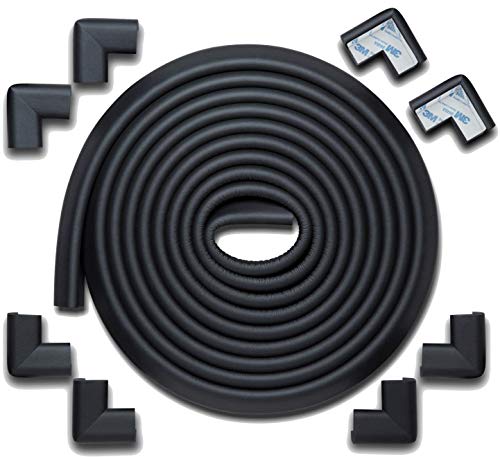
Roving Cove HeftyFit Edge Corner Protector, 18ft Edge + 8 Corners, Onyx Black
A jumbo set covering 20.4 feet, made up of 18 ft of edge guard and 8 corner guards, which is enough to do a hearth and a table in one order. The profile is the heavy-duty one at 0.4 in thick and 0.8 in deep NBR rubber foam, aimed at maximum impact absorption rather than a low profile, and it fits round tables up to 69 in across, square up to 56 in, or rectangles up to 36 x 78 in. Onyx black is the real reason to pick it, because it is made for dark furniture, hearths and fireplaces where an off-white bumper would stand out. Roving Cove states the same Shore A 20-N density and the same no-SCCP, no-BPA material as its other lines; the 8 corners are pre-taped and the kit includes 36 ft of 3M double-sided tape for the edge guard.
- Brand
- Roving Cove
- Category
- Best for Fireplaces & Dark Furniture
Our brick hearth was the one thing I could not simply move out of the room, and in black these honestly disappear against it.

POIKSHARK Clear Edge Corner Protector, 6.6ft + 8 Corners
A 2-meter (6.6 ft) roll of clear edge protection measuring 0.8 in by 0.8 in, plus 8 L-shaped corner guards, all with adhesive already applied. The strip cuts to length, so you can cover the two sharp sides of a TV stand or one awkward shelf without buying a whole room's worth. The clear finish is meant to disappear against the furniture and be less interesting to a curious toddler, and POIKSHARK states the PVC is BPA-free and free of heavy metals. Check your surface first: the maker lists wood, glass, marble, metal, porcelain, tile, cement and plastic as suitable, and specifically advises against gypsum, paper, untreated wood, sink tops and uneven surfaces.
- Brand
- POIKSHARK
- Category
- Best Budget Combo
Six and a half feet was exactly enough for the two sharp sides of our TV stand, and cutting it to length took one pass with kitchen scissors.

Roving Cove HeftyFit Corner Protector, 4 Large Corners, Oyster White
Four large corner guards and nothing else, for the very common case where the corners are the hazard and the long edge is not. They use the same heavy-duty HeftyFit profile as the jumbo set, at 0.4 in thick rubber foam, and they arrive pre-taped with 3M 9448A double-sided tape, so there is no separate taping step to get wrong. Roving Cove states the same Shore A 20-N density and the same no-SCCP, no-BPA, no-phthalate material as the rest of its range. Oyster white is aimed at light-colored tables, chests, shelves and hearths.
- Brand
- Roving Cove
- Category
- Best Corners-Only
Four corners, four minutes, done before nap time ended. I did not need fifteen feet of anything.
- 01
- 02Wappa BabyBest Clear / Least VisibleWappa Baby Transparent Corner Protectors (12 Pack)
- 03Roving CoveBest for Fireplaces & Dark FurnitureRoving Cove HeftyFit Edge Corner Protector, 18ft Edge + 8 Corners, Onyx Black
- 04POIKSHARKBest Budget ComboPOIKSHARK Clear Edge Corner Protector, 6.6ft + 8 Corners
- 05Roving CoveBest Corners-OnlyRoving Cove HeftyFit Corner Protector, 4 Large Corners, Oyster White
Do corner guards actually prevent injuries?+
Will the adhesive ruin my furniture?+
How do I measure how much edge guard I need?+
Should I get clear corner protectors or foam ones?+
What if my toddler keeps pulling the corner guards off?+
When can I take corner guards down?+
Sammie Seelbach
Sammie is a mom of two and the lead reviewer at Smart Baby Reviews. Since becoming a parent she has become obsessed with researching the safest, smartest baby gear on the market — testing thermometers at 2 a.m., wrangling baby gates, and sterilizing more bottles than she can count. She shares what actually works so other parents can make confident, informed decisions for their little ones.