Baby-Proofing Stairs and Banisters

This post may contain affiliate links. Read our policy.
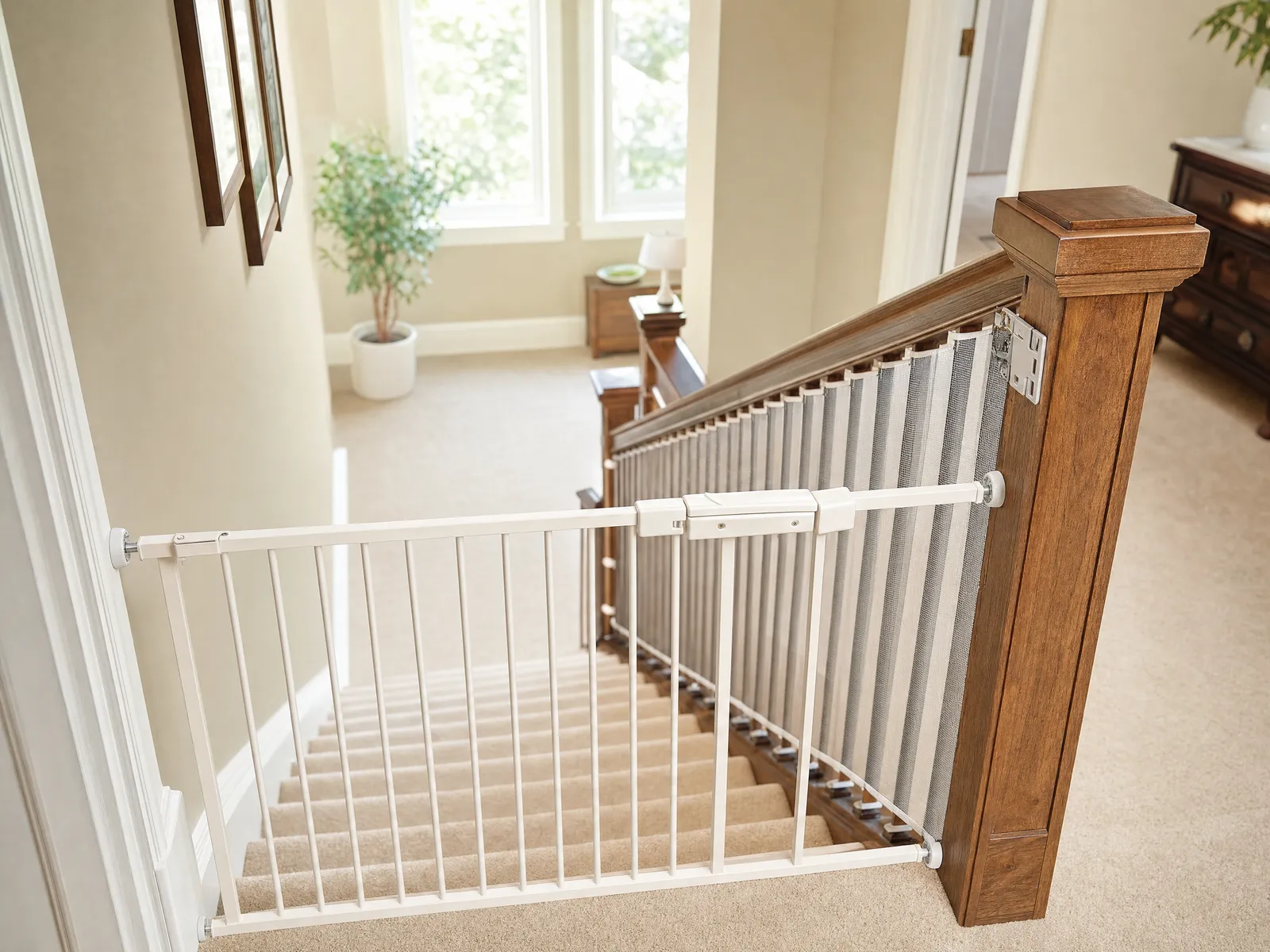
Baby proofing stairs is really two jobs, not one. You need a hardware-mounted gate at the top, some kind of barrier at the bottom, and then you need to close the gaps in the banister so a small body cannot slide through the balusters. Get those three things right and the staircase stops being the thing you brace against all day. Some of the links below are affiliate links, and we may earn a small commission — at no extra cost to you — if you buy through them.
Here is what makes stairs different from every other hazard in the house: you cannot put them away. The cleaning bottles go in a high cupboard. The houseplant moves. The scissors go in a drawer with a lock on it. The staircase stays exactly where it is, all day, every day, for the entire eighteen months your child is fast enough to reach it and not yet coordinated enough to survive it. When I was working through how to baby-proof your home with my first, everything else on the list felt like tidying. The stairs felt like the actual problem.
The two ends of a staircase are two different problems
The numbers here are worth sitting with, because they explain why stairs get treated separately from the rest of the house. According to research published in Pediatrics by Nationwide Children's Hospital, more than 93,000 children under five were treated in US emergency departments for stair-related injuries every year between 1999 and 2008 — which the hospital translates as a child under five arriving at an emergency department for a stair injury roughly every six minutes. About three-quarters of those injuries were to the head and neck.
The encouraging part of the same study is that the annual number of injuries fell significantly over that decade — by 11.6%. The researchers do not credit any single fix for that decline, but the study's senior author points to a combination of educating parents, use of stair gates, and modifying building codes to make stairs safer as the way these injuries get prevented.
But the top and the bottom of a flight are not the same hazard, and they do not get the same solution:
- At the top, the risk is a fall down the entire flight. The barrier has to be anchored, because it is the only thing between your child and the drop.
- At the bottom, the risk is an unsupervised climb that ends in a fall from partway up. The barrier is stopping access, not holding back a falling body.
That distinction drives almost every decision below.
The top of the stairs: hardware-mounted, and nothing else
A pressure-mounted gate stays up because it is wedged between two walls. That is fine across a doorway. At the top of a staircase it is a trapdoor, because the moment it lets go, the gate and the child go down together. The American Academy of Pediatrics puts it plainly in its home safety guidance: install safety gates at both the top and bottom of stairs when your child is learning to crawl and walk, and use gates that are firmly mounted to the home's studs.
Three details matter at the top specifically, and they are the reason I like the Toddleroo Easy Swing and Lock Stair Gate there:
- It has to be screwed in. The Toddleroo must be installed with its included hardware, which means drilling into the wall or the newel post. That is not a downside — it is the whole point.
- It must not swing out over the stairs. A gate that opens over the drop puts you off balance on the top step while you are holding a child. The Toddleroo has a swing control that sets the direction, and the maker says never to allow it to swing over the stairs.
- No threshold bar. A raised bar across the bottom of the opening is a trip hazard at the exact spot where tripping is worst. The Toddleroo has none.
The AAP also advises avoiding accordion-style gates, which can trap an arm or a neck. That warning has history: in January 1985 the CPSC announced an agreement with six manufacturers to halt production and distribution of V-shaped accordion-style gates, after an eighth death and at least 23 other non-fatal incidents in which children's heads became entrapped in the V-shapes along the top edge or in the diamond-shaped openings in the body of the gate. If a relative offers you one from the attic, thank them and recycle it.
For everything else about gates — measuring your opening, latch styles, living with one twenty times a day — I wrote a separate guide on choosing and fitting a baby gate. This article stays on the staircase itself.
The bottom of the stairs, where the rule relaxes
Plenty of parents skip the bottom gate, and I understand the logic: nobody falls down from the bottom step. But the bottom gate is doing something else. It stops the silent climb — the one where your child gets six steps up while you are loading the dishwasher, then turns around to look for you.
Because there is no drop behind it, a pressure-mounted gate is generally acceptable at the bottom of a flight. Mount it at the very bottom, on the floor, rather than up on the second or third tread. A gate perched on a step gives a child a landing pad to climb onto, and it leaves you stepping over a bar in mid-flight.
When your climber outgrows a standard gate
Some toddlers treat a 30-inch gate as a suggestion. If yours has started swinging a leg over the top, an extra-tall model buys you time — the Ingenuity Extra Tall Gate stands 36 inches including the arch. Read the fit list before you order, though, because it is unusual: it covers openings from 28.5 to 48 inches, but the maker states it will not fit openings of 32-33 in, 36-37 in, 40-41 in or 44-45 in. And note that while it pressure-mounts in a doorway, the included hardware kit is required for stair use.
The banister and balusters: the gap that actually matters
This is the part most people skip, and it is the one I would check tonight. Take a tape measure to the clear gap between two balusters.
Modern US residential code answers this with a sphere test rather than a single number. Under the International Residential Code, a required guard must not have openings that allow a 4-inch sphere to pass through, from the walking surface up to the required guard height. There is an exception for the open side of a stair, where the limit is a 4-3/8-inch sphere, and the triangular opening formed by the riser, tread and bottom rail must not pass a 6-inch sphere. The 4-inch figure exists because a gap that size is about where a small child's head enters the picture — either the body slips through, or it does not and the head is caught.
If your house is old, decorative, or was renovated by an enthusiast, there is a decent chance your railing does not meet that. Mine did not.
The practical fix is a banister guard: a taut panel of mesh cable-tied along the railing so nothing gets through the balusters. For a standard flight I would use the Roving Cove Banister Guard, which covers a 10 ft by 3 ft span in see-through mesh and installs with reusable cable ties in two lengths — 19 inches for a chunky newel post, 12.25 inches for a normal banister — with no drilling at all. As of August 2026 it is $22.69, which is a rounding error next to the cost of a gate. For a short landing or a half-wall, the 5-foot Roving Cove guard in ebony black disappears against dark railings.
Be clear-eyed about what a net does. It stops a child, a pet or a toy going through the gaps in a railing. It is not a structural barrier, it does not carry weight, and it does not make a railing climb-proof. It closes one specific hole in your setup — a real one, but only one.
Horizontal railings and the climbing problem
Horizontal rails, ranch-style railings and wide-spaced balusters have a second problem beyond the gaps: they are a ladder. Every horizontal member is a rung. A child who cannot fit through the railing can still go over it, and going over is worse.
A taut mesh guard helps by covering the obvious footholds, and for a long run or a balcony edge the JIFTOK Stairway Net covers 18 ft by 2.66 ft in one piece, with 60 zip ties and lashing rope in the box and two nets joinable for anything longer. But it is still fabric. If your child is actively trying to climb the railing, the real answer is a gate that keeps them off that landing entirely, and supervision until they lose interest.
The landing, and what you keep on it
A landing is a floor with a drop on one side, and everything you would normally do to a room applies double. A bookcase, a console table or a plant stand beside a railing is both a climbing platform and a tip-over risk, and a piece of furniture that comes down on a landing can carry a child over the edge with it. Anchor anything tall up there — my guide to anti-tip furniture anchors covers how to find a stud and which straps hold. Better yet, move it. A landing does not need a bookcase.
Baskets and laundry piles on a landing deserve the same treatment. Anything that turns into a step is a step.
When the fix is a lock, not a gate
Not every staircase needs a gate. If the flight in question is a basement stair, an attic stair or a garage step-down, the door at the top of it is a much better control point than the treads below. A door that latches is a full barrier, it does not need to be stepped over forty times a day, and it does not leave holes in your trim. My guide to door knob covers and locks walks through the options, including which ones adults can actually operate while carrying laundry.
Basement stairs in particular are often steeper and less well lit than the main flight, which is a good argument for keeping the door shut on principle.
The treads themselves
Once the barriers are up, the surface is what is left. The AAP suggests considering carpeting stairs to prevent slips and falls, and adds a condition that matters more than the carpet itself: be sure it is firmly tacked down at the edges. A runner that curls or slides is worse than bare wood, because it fails at the moment weight lands on it.
Three other things that cost nothing:
- Socks. Smooth socks have next to no grip on wood or on a stiff runner, and adults on stairs are frequently carrying a baby. The National Institute on Aging advises not walking on stairs or floors in socks, or in shoes and slippers with smooth soles. Grippy socks or bare feet.
- Clutter. No toys, shoes or folded laundry on the treads, ever. The "leave it on the stairs to take up later" pile is a genuine hazard in a house with a baby.
- Light. A switch or a motion light at both ends of the flight. Most of the stair traffic in a house with a newborn happens at 2am.
Teaching the stairs, without relying on it
At some point your child learns stairs, and that is a safety measure in itself — but a slow-acting one, and no substitute for the hardware. We taught ours to come down backwards on hands and knees, feet first, because it is the position they can control and it keeps their eyes on the step they are actually leaving.
Two habits from Nationwide Children's Hospital are worth teaching as soon as a child is using stairs with you: always keep one hand free for the handrail, and ask an adult for help before carrying anything up or down. That second one is not fussiness. In the same research, about a quarter of stair injuries to children under one happened while the child was being carried, and those children were more than three times as likely to be hospitalized as children injured other ways. Which means the rule applies to you too: one hand on the rail, and make two trips.
The hospital's own framing is the one I would keep: stair gates are important and effective, but they are not a substitute for adult supervision.
If you only do one thing this weekend
In order, this is how I would spend the time:
- Hardware-mount a gate at the top of the stairs. Nothing else on this list matters as much.
- Measure the gaps in your banister and net them if they are wider than they should be.
- Put a gate at the bottom. Pressure-mounted is fine here.
- Clear and anchor the landing. Nothing tall, nothing climbable, nothing loose.
- Fix the surface. Tack the runner down, kill the sock habit, add a light.
The bottom line
The staircase is the one hazard in your house that cannot be relocated, so it earns more attention than anything else on the childproofing list. Anchor the gate at the top into studs, use whatever is convenient at the bottom, close the gaps in the railing, keep the landing bare, and teach the backwards climb early. None of that makes a staircase safe — nothing does — but together they turn a daily source of dread into something you can walk past without flinching.
When you are ready to keep going, my full guide to baby-proofing the rest of your home picks up where this one leaves off, room by room. Measure your banister first, though. It takes thirty seconds, and it is the number most parents have never checked.

Toddleroo Easy Swing & Lock Baby Gate for Top of Stairs, 31 in Tall, Bronze
This is a hardware-mounted gate, which means it must be installed with the included hardware and you will be drilling into the wall or the newel post — and that is exactly why it is the pick for the top of a staircase. It fits openings from 28.68 to 47.85 inches, stands 31 inches tall, and is designed to be difficult to climb, with no threshold bar in the walk-through opening to catch your toe on the way down. A swing control lets you set which direction the door opens, and the maker is explicit that you should never allow it to swing out over the stairs. The brand states it is Baby Safety Alliance and ASTM certified for use at the top or bottom of a staircase, and it opens one-handed: thumb on the upper latch button, lift, then push or pull.
- Brand
- Toddleroo by North States
- Category
- Our Pick
Drilling four holes into our trim felt drastic right up until the afternoon my son threw his whole body at it and it did not move a millimeter.

Roving Cove Stair Banister Guard 10ft x 3ft, Pearl White
A 10 ft by 3 ft panel of heavy-grade fabric mesh that the maker says resists pulls and tears, sized to cover a typical flight of stairs. It is see-through, so it does not block your view of a child on the stairs, and it installs with releasable, reusable cable ties in two lengths — 19 inches for a large newel post or hand rail, 12.25 inches for a regular banister — plus 3M pre-taped tie mounts to snug the bottom and sides down. The sides and bottom roll back so you can customize the length to your railing rather than cutting it. It wipes clean with soap and a sponge, or comes off entirely and goes in the wash.
- Brand
- Roving Cove
- Category
- Best Banister Guard
I could still see her through it from the kitchen, which mattered to me more than I expected — it closed the gaps without turning our stairs into a tunnel.

Ingenuity Decorative Extra Tall Baby Gate & Dog Gate, 28.5-48 in Wide, 36 in Tall
At 36 inches tall including the arch, this stands taller than a standard gate, which is the point once you have a determined climber. It pressure-mounts in doorways and hallways, but the included hardware kit is REQUIRED for stair use — do not use it at the top of stairs on pressure alone. It mounts to walls, doorways or flat banisters, a stopper keeps the door from swinging out over the top of the stairs, and the door auto-closes when it is opened less than 90 degrees. Measure before you buy: it fits openings from 28.5 to 48 inches, but the maker states it will NOT fit openings of 32-33 in, 36-37 in, 40-41 in or 44-45 in.
- Brand
- Ingenuity
- Category
- Best Extra-Tall Gate
I measured our opening twice because of that odd fit list, and I am glad I did — we landed at 38 inches and it went up in an evening.

JIFTOK Stairway Net Banister Guard, 18 ft L x 2.66 ft H, Black
At 18 ft long by 2.66 ft high, this covers a long run of railing or a balcony landing in one piece, and two nets can be joined for something longer still or one folded down for a shorter run. It ships with 60 zip ties and 15 lengths of lashing rope, so there is no drilling involved. The maker describes the thick mesh fabric as tear-resistant and weatherproof, and the honeycomb holes keep your sight line through the net. It is made to stop children, pets and toys dropping through railings on staircases, balconies and windows.
- Brand
- JIFTOK
- Category
- Best for Long Railings
Our landing railing is a long one and I had resigned myself to buying two nets — this covered the whole run with rope left over.

Roving Cove Stair Banister Guard 5ft x 3ft, Ebony Black
The same heavy-grade, tear-resistant, see-through mesh as the larger Roving Cove guards, cut to a 5 ft by 3 ft span — sized for a short landing, a half-wall or a single flight rather than a whole staircase. The ebony black blends into dark-stained railings and black metal balusters instead of announcing itself. It installs with releasable, reusable cable ties in two lengths plus 3M pre-taped tie mounts, and the sides and bottom roll back to fine-tune the fit. It wipes clean or can be taken off and washed.
- Brand
- Roving Cove
- Category
- Best for Short Runs
Our half-wall landing only needed about four feet of coverage, and in black it honestly reads as part of the railing rather than baby gear.
- 01Toddleroo by North StatesOur PickToddleroo Easy Swing & Lock Baby Gate for Top of Stairs, 31 in Tall, Bronze
- 02Roving CoveBest Banister GuardRoving Cove Stair Banister Guard 10ft x 3ft, Pearl White
- 03IngenuityBest Extra-Tall GateIngenuity Decorative Extra Tall Baby Gate & Dog Gate, 28.5-48 in Wide, 36 in Tall
- 04JIFTOKBest for Long RailingsJIFTOK Stairway Net Banister Guard, 18 ft L x 2.66 ft H, Black
- 05Roving CoveBest for Short RunsRoving Cove Stair Banister Guard 5ft x 3ft, Ebony Black
Can I use a pressure-mounted gate at the top of the stairs?+
How wide can the gaps in a banister be?+
Do I need a gate at the bottom of the stairs too?+
When can my toddler use the stairs on their own?+
What do I do about a horizontal railing my child can climb?+
Are carpeted stairs safer than bare wood?+
Sammie Seelbach
Sammie is a mom of two and the lead reviewer at Smart Baby Reviews. Since becoming a parent she has become obsessed with researching the safest, smartest baby gear on the market — testing thermometers at 2 a.m., wrangling baby gates, and sterilizing more bottles than she can count. She shares what actually works so other parents can make confident, informed decisions for their little ones.