The Best Anti-Tip Furniture Anchors to Prevent Tip-Overs

This post may contain affiliate links. Read our policy.
The safest furniture anchors for baby proofing are simple metal straps that screw a dresser, bookcase, or TV stand into a wall stud — with no-drill adhesive and clamp kits close behind for renters and hard walls. My top pick is the all-metal Booda Brand strap, and below are five anchors I trust across drill and no-drill setups. Some of the links below are affiliate links, and we may earn a small commission — at no extra cost to you — if you buy through them.
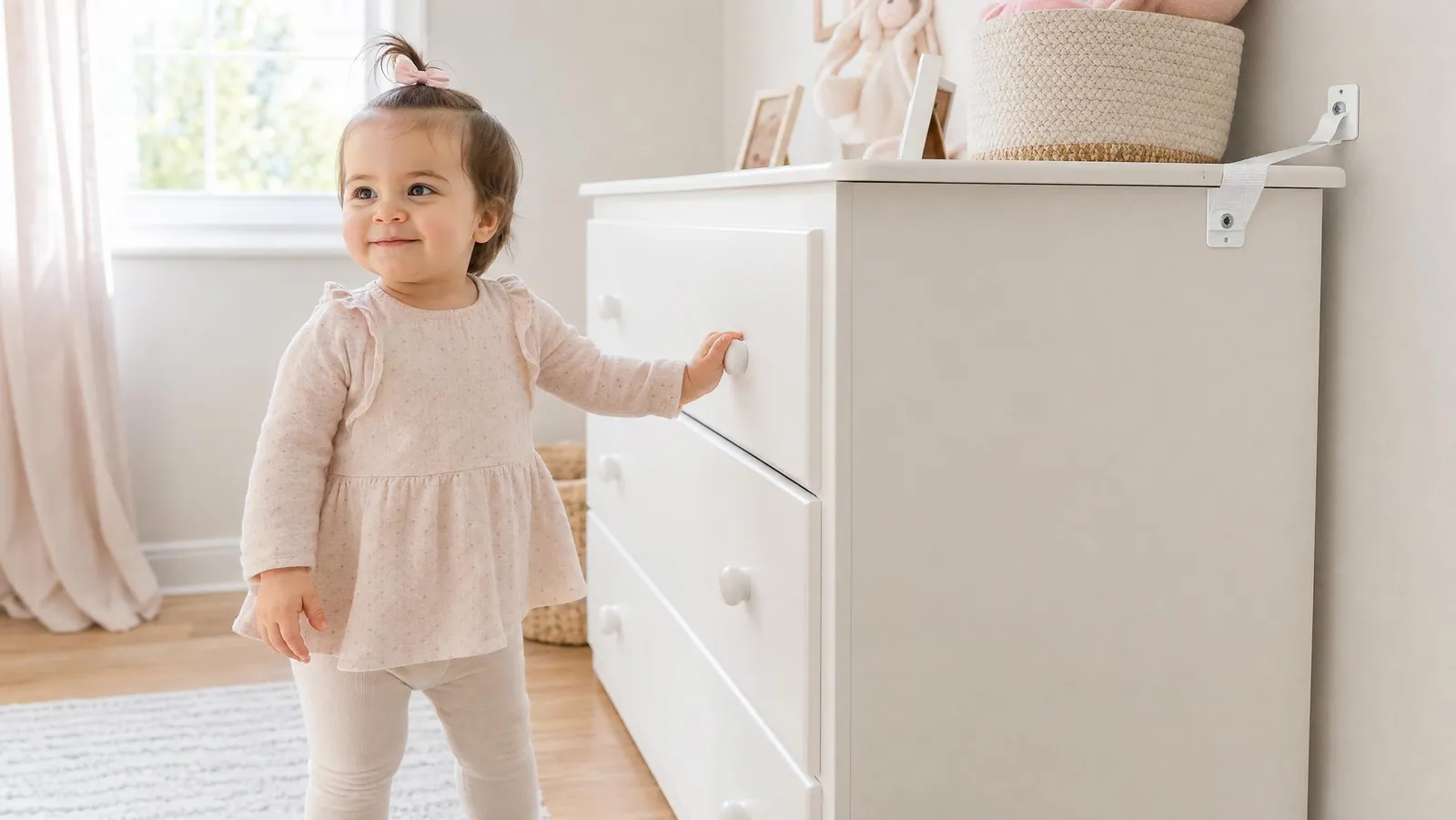
I didn't take tip-overs seriously until I watched my 18-month-old plant one foot on an open bottom drawer and haul himself up like a tiny mountaineer. The dresser rocked forward, I lunged, and nothing fell — that time. That weekend I anchored every heavy piece in the house, and it's now the first thing I do in any room. If you're just starting on baby-proofing your home, furniture anchors belong right at the top of the list, alongside outlet covers and stair gates.
Why furniture tip-overs are worth taking seriously
Tip-overs sound like a freak accident until you look at how often they happen. According to the U.S. Consumer Product Safety Commission (CPSC), an estimated 17,800 people a year are injured in furniture, TV, and appliance tip-overs, and children under 18 account for 44% of those injuries — which works out to roughly one child treated in an emergency room every 53 minutes.
The fatal cases follow the same pattern. Since 2000, the CPSC has recorded 581 tip-over deaths involving furniture, TVs, or appliances, and 472 of them — more than eight in ten — were children. Ninety-three percent of those child deaths involved kids five years old and younger, the exact age when climbing outpaces judgment.
The reason toddlers are hit so hard is mechanical, not careless. CPSC data show a chest, dresser, or bureau is the single most common type of furniture involved in child tip-over fatalities, largely because open drawers turn a dresser into a climbable ladder. A heavy piece isn't safer here — it's more dangerous, because there's more mass behind it when it goes.
There is real good news, though: the CPSC credits its Anchor It! campaign, launched in 2015, with helping drive a nearly 50% decline in tip-over injuries and deaths. Anchoring works. It's one of the highest-payoff ten-minute jobs in the entire house.
Anchoring is for every tall piece, not just the climber's dresser
It's tempting to think anchoring is only for the dresser your climber has claimed. It isn't. The American Academy of Pediatrics (AAP) recommends anchoring furniture and TVs to the wall, and notes that the heavier the furniture, the more anchors you should use. Bookcases, wardrobes, shelving units, tall cabinets, and media stands all belong on the list — anything that could pin a small body if it came down.
TVs deserve special attention. The AAP points out that a flat-screen can weigh as much as one or two bowling balls, and it specifically warns against ever placing a TV on top of a dresser — a combination that puts a heavy, tippable object right at a child's eye level, on top of the very drawers they'll use to climb. Any TV that isn't wall-mounted should be strapped to the wall or to the stand it sits on.
Furniture itself is getting sturdier. After the STURDY Act was signed into law in December 2022, the CPSC adopted ASTM F2057-23 as a mandatory stability standard for dressers and other clothing-storage units, effective September 1, 2023. The standard tests units on carpet, with loaded and open drawers, and against the simulated weight of a child up to about 60 pounds. New dressers are safer than they used to be — but anchoring is still your backstop, and it's essential for everything you already own.
How to choose anti-tip furniture straps and anchors
There are a handful of formats, and the right one depends on what you're anchoring and what your walls will allow.
Metal strap kits (the drill option)
The workhorse of furniture anchoring is a metal anti-tip furniture strap: one bracket screws into a wall stud, the other into the back of the furniture, and a short steel strap or cable links the two. These are inexpensive, come in multipacks, and are the strongest choice whenever you can drive a screw into a stud. Buy a pack and you can do a whole house in an afternoon.
No-drill and clamp anchors (for renters and hard walls)
If you rent, or you're dealing with plaster, tile, or concrete, look at no-drill furniture wall anchors. Some use heavy adhesive patches paired with a hook-and-loop strap; others use a punch-free clamp that grips the furniture itself, so you never touch the wall. They aren't quite as bombproof as a stud-mounted strap, but a well-applied no-drill anchor is dramatically safer than an unanchored dresser. Just plan to re-check the adhesive every few months.
TV anti-tip straps
A television needs its own solution. TV anti-tip straps typically bolt to the VESA holes on the back of the screen using the included machine screws, then anchor to the wall or the media unit. If your TV sits on a dresser or console rather than a wall mount, strap it down — a curious toddler pulling on a screen is exactly the scenario these prevent.
Drilling into a stud vs. drywall
Wherever you can, anchor into a wall stud, not bare drywall. The little screws in most kits will pull straight out of drywall under a child's full weight. Use a stud finder, and if there's no stud where you need one, step up to heavy-duty drywall anchors rated for the load, or switch to a clamp-style anchor that doesn't rely on the wall at all. Either way, use at least two anchors per piece, spread across the top.
Installing a furniture anchor step by step
Most straps take about five minutes per piece, and you don't need to be handy. Here's the routine I use:
- Find a stud. Run a stud finder along the wall behind the furniture and mark it. Studs are usually spaced 16 inches apart, so once you locate one, the next is easy to find.
- Empty the top drawers. Pull the furniture a few inches from the wall and open the top so you can reach the back panel comfortably.
- Mount the furniture bracket. Screw one bracket into a solid part of the furniture's back or top rail — into the frame, not the thin backing board, which can tear out.
- Mount the wall bracket. Drive the other bracket into the stud at roughly the same height, then connect the strap or cable between the two.
- Snug it up. Push the furniture back against the wall, leaving the strap taut but not stretched, then give the piece a firm pull to confirm nothing shifts.
Repeat for every tall piece in the room. Two anchors is the floor; a wide dresser or a fully loaded bookcase is happier with three. And re-check them a couple of times a year, since screws can work loose and adhesive can weaken over time.
The best furniture anchors for baby proofing
Here are the five I'd actually put on my own furniture, from the all-metal set I reach for first to a no-drill kit renters can use anywhere. Four are strap kits at different price and strength levels, and one is a no-drill adhesive-and-clamp system for walls you can't touch. The cards below carry the current pricing and full specs — here's how I'd choose between them.
Our pick: all-metal and built to last
For most dressers, bookcases, and cabinets, I reach for the Booda Brand Metal Furniture Anchors. Every part is metal — no plastic clips to fatigue and snap after a year on a sun-warm wall — and the maker states that two straps together withstand up to 400 pounds. The 10-pack includes screws, steel wire straps, brackets, and expansion nails, which is enough hardware to anchor several pieces at once, and each strap detaches when you need to slide the furniture out to clean. If you buy one thing off this list, make it this.
Best value: ten straps, done in an afternoon
The 4our Kiddies Furniture Anchors do the same core job for less. You get ten stainless-steel wall anchor straps the maker rates to hold up to 400 pounds each, and they install in minutes with a screwdriver or drill in either a vertical or horizontal orientation. They're corrosion- and heat-resistant and detach for cleaning. With ten in the box, this is the pack I'd hand a new parent who wants to anchor the whole house in one pass without overthinking it. As of July 2026 it's one of the cheapest ways to get that done.
Best for TVs: no drilling required
If the job is a television, the HMOKGRT No-Drill TV Safety Straps skip the drill entirely. The kit is 16 feet of cut-to-length hook-and-loop strap plus eight adhesive patches — enough to make four straps. You clean the surface, press on a patch, and secure the strap; because the hook and loop are on the same side, the strap grips itself for an adjustable hold. It's built for flat-screen TVs but works on dressers, bookshelves, mirrors, and cabinets too. This is what I'd use on an older bedroom TV that never had a home on the wall.
Best no-drill and renter-friendly: clamp it, don't drill it
Renters, this one's for you. The IMtKotW TV and Furniture Wall Anchors give you two mounting routes: a standard wall anchor, or a punch-free metal C-clamp that grips a desk or shelf up to 1.77 inches thick — so you can anchor a TV to your own console instead of the landlord's wall. It comes with a full set of VESA screws (M4 through M8) for the back of a TV, an adjustable buckle strap, and metal connectors, and the manufacturer backs it with a five-year warranty. Flexible, and no holes required.
Premium heavy-duty: steel cable for the tallest pieces
For a very tall or top-heavy piece — a loaded bookcase, a full-length mirror, a filing cabinet — I like the extra margin of the Hangman Steel Anti-Tip Kit. It's built from galvanized aircraft-steel cable and steel hardware instead of webbing, the maker states it holds up to 400 pounds, and the tamper-resistant design matters once a toddler learns to pick at a strap. It costs more than the multipacks, but for the one piece you worry about most, it's worth it.
A few habits that make anchoring work harder
Anchors do the heavy lifting, but a couple of free habits stack the deck further. The AAP suggests loading heavier items into the lowest drawers and lighter ones up top, so the center of gravity stays low. Keep the tempting stuff — the remote, a favorite toy, anything that whispers climb me — off the top of tall furniture. And add drawer stops or straps so drawers can't be pulled all the way out and used as steps. None of it replaces a wall anchor, but together they make a tip-over far less likely.
Anchor the room, not just the dresser
Anchoring is one layer of a larger pass. Once the heavy furniture is strapped down, I work around the room at toddler height: cabinet and drawer locks on anything holding cleaners, medicines, or breakables; outlet covers; and cord wind-ups for the blinds. Drawers are worth a second look, since they're what a climber uses to scale a dresser in the first place — locks that stop drawers from opening all the way take the ladder out of the equation.
Then think about where your child can and can't go. Blocking off a staircase or a not-yet-babyproofed room with a solid baby gate keeps them out of the spaces you haven't reached yet — and away from the tall furniture in the home office or guest room while you finish the job.
The bottom line
Furniture anchors are the rare safety upgrade that's cheap, fast, and genuinely life-saving. Strap every tall or top-heavy piece — dressers, bookcases, wardrobes, and any TV that isn't on the wall — using at least two anchors per piece and driving into a stud wherever you can. If you rent, a no-drill or clamp kit still beats leaving furniture loose by a mile. Start with the all-metal Booda set, add TV straps where you need them, and step up to steel cable for the one piece that keeps you up at night.
Then keep going. Furniture anchoring is one chapter of a bigger project, and my full guide to baby-proofing every room walks through the rest, room by room. Give yourself the ten minutes per dresser — it buys back a whole lot of peace of mind.

Booda Brand Furniture Anchors (10 Pack), Metal Anti-Tip Straps
All-metal straps that screw into a wall stud and the back of the furniture, with no plastic parts to crack or fatigue over time. The maker states that two straps together withstand up to 400 pounds, and the stainless-steel build is corrosion- and flame-resistant. The 10-pack includes screws, steel wire straps, brackets, and expansion nails, so you can anchor several pieces at once, and each strap detaches when you need to move or clean behind a dresser. It works on dressers, bookcases, cabinets, TV stands, and wardrobes.
- Brand
- Booda Brand
- Category
- Our Pick
Ten minutes with a drill and I finally stopped bracing every time my son reached for the dresser drawers.

4our Kiddies Furniture Anchors (10 Pack), Anti-Tip Straps
A budget 10-pack of stainless-steel wall anchor straps that the maker states hold up to 400 pounds each. They install in minutes with a screwdriver or drill and mount either vertically or horizontally to suit the piece. The straps are corrosion- and heat-resistant and detach so you can pull furniture out to clean. With ten in the box, it is an easy way to anchor every dresser, bookcase, and cabinet in the house in a single pass.
- Brand
- 4our Kiddies
- Category
- Best Value
I anchored every heavy piece in our two-bedroom apartment for about the cost of a coffee run, and I kept the leftover straps for the next thing we buy.

HMOKGRT 4 Pack Cut-to-Length TV Safety Straps, No-Drill
A no-drill kit built around 16 feet of cut-to-length hook-and-loop strap plus eight adhesive patches, enough to make four straps. You clean the surface, press on the adhesive patch, and secure the nylon strap, with no holes in the wall or the furniture. Because the hook and loop sit on the same side, the strap grips itself for an adjustable hold. It is made for flat-screen TVs but also works on dressers, bookshelves, mirrors, and cabinets.
- Brand
- HMOKGRT
- Category
- Best for TVs
This is what finally got the old bedroom TV strapped down — no stud finder, no drill, just peel and press while the baby napped.

IMtKotW TV & Furniture Wall Anchors with Punch-Free Clamp (VESA)
This kit gives you two ways to anchor without committing to holes: a standard wall anchor, or a punch-free metal C-clamp that grips a desk or shelf up to 1.77 inches thick. It ships with a full set of VESA screws (M4 through M8) so you can bolt the strap to the back of a TV, and a buckle lets you adjust the strap length. The connectors are metal rather than plastic, and the manufacturer backs it with a five-year warranty. It is my pick for renters who cannot drill into the wall.
- Brand
- IMtKotW
- Category
- Best No-Drill / Renter-Friendly
We rent, so the clamp option was perfect — I anchored the TV to our own console instead of the landlord's wall, and it has not shifted since.

Hangman Anti-Tip Kit to Prevent Furniture Falling — Steel (TK-400-3)
A heavier-duty anchor built from galvanized aircraft-steel cable and steel hardware rather than webbing. The maker states it holds up to 400 pounds and uses a tamper-resistant design, which helps once a toddler figures out how to pick at a strap. Beyond dressers, it is rated to help hold filing cabinets and full-length mirrors in place. If you want the sturdiest option and do not mind paying more, this is it.
- Brand
- Hangman
- Category
- Premium Heavy-Duty
The steel cable feels indestructible next to the fabric straps — this is the one I used on the tall, top-heavy bookcase in our hallway.
- 01Booda BrandOur PickBooda Brand Furniture Anchors (10 Pack), Metal Anti-Tip Straps
- 024our KiddiesBest Value4our Kiddies Furniture Anchors (10 Pack), Anti-Tip Straps
- 03HMOKGRTBest for TVsHMOKGRT 4 Pack Cut-to-Length TV Safety Straps, No-Drill
- 04IMtKotWBest No-Drill / Renter-FriendlyIMtKotW TV & Furniture Wall Anchors with Punch-Free Clamp (VESA)
- 05HangmanPremium Heavy-DutyHangman Anti-Tip Kit to Prevent Furniture Falling — Steel (TK-400-3)
Do heavy dressers still tip over if they feel solid?+
Drill or no-drill — what should renters use?+
How many anchors does each piece of furniture need?+
Do furniture anchors work if I cannot find a wall stud?+
Are cheap anti-tip straps strong enough?+
Sammie Seelbach
Sammie is a mom of two and the lead reviewer at Smart Baby Reviews. Since becoming a parent she has become obsessed with researching the safest, smartest baby gear on the market — testing thermometers at 2 a.m., wrangling baby gates, and sterilizing more bottles than she can count. She shares what actually works so other parents can make confident, informed decisions for their little ones.