Do You Actually Need a Baby Food Maker?

This post may contain affiliate links. Read our policy.
No. For most families a baby food maker is not worth it. The machine does two things — it steams, and it blends — and a silicone steamer basket plus a cheap stick blender do both for about a third of the price, and still work when your child is twelve. Some of the links below are affiliate links, and we may earn a small commission, at no extra cost to you, if you buy through them.
I owned one. It sat on the counter for five months, made maybe forty trays of squash and pear, and went to a charity shop the week my daughter decided purees were beneath her.
That is the honest answer, not the whole answer. Four situations make a dedicated machine the right buy, and none are about nutrition or safety — they are about your sink, your hob, your cupboard and your Sunday. Our pillar guide to starting solids covers readiness and the first month; this one is only about the appliance.
Is a Baby Food Maker Worth It? What the Machine Actually Does
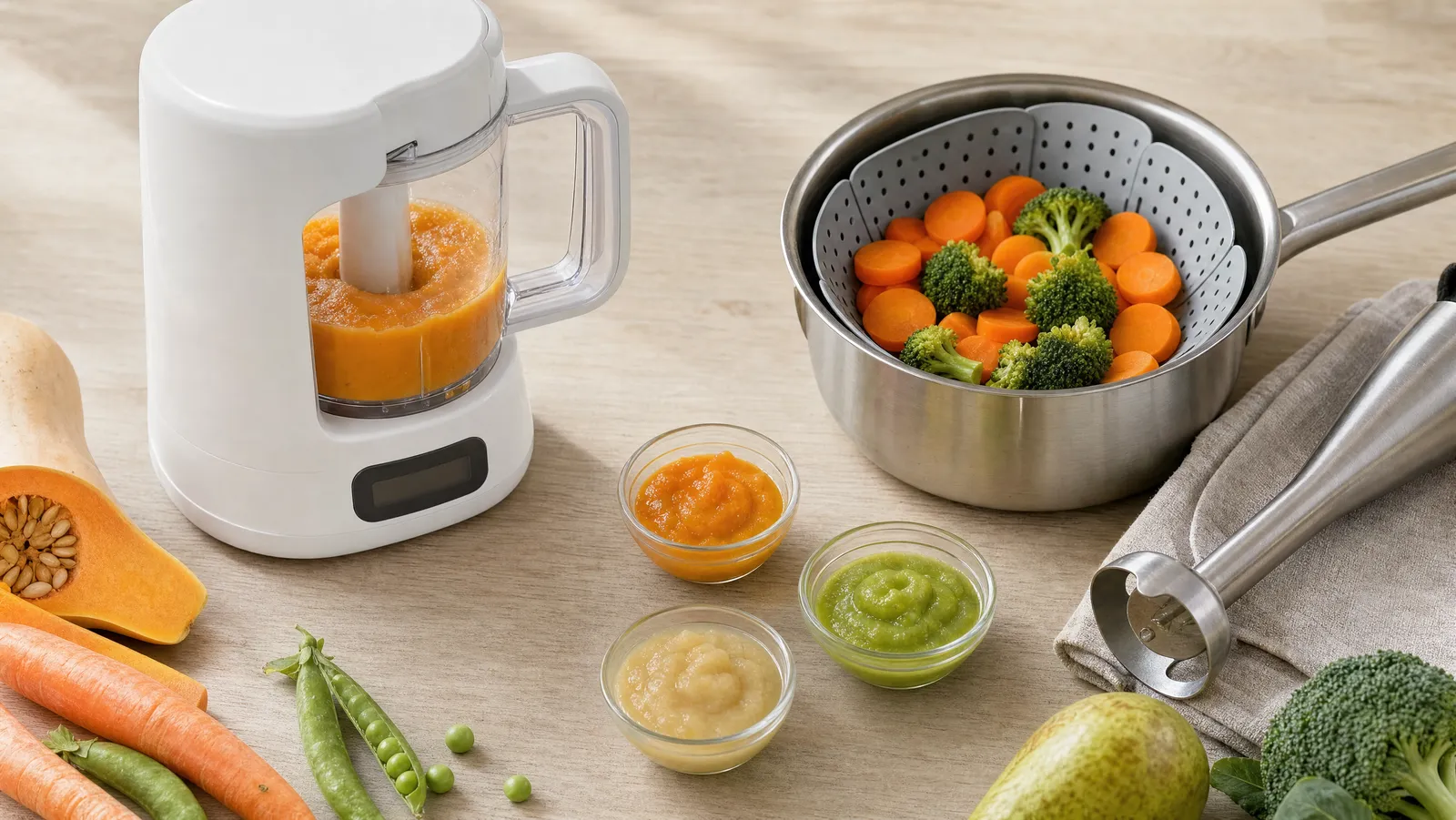
A baby food maker is a small steamer with a blade in the bottom of the bowl. Water in the tank, food in the bowl, press a button: steam cooks it, then the same bowl blends it. Touch screens and recipe books are packaging around steam plus blade. So the question is not whether a baby food maker is worth it in the abstract, but whether steam-plus-blade in one bowl is worth $60 to $90, when steam and blade bought separately cost under $30.
Not every "baby food maker" steams. The NutriBullet Baby Complete System, one of the best-known names in the category, is a motor base, a batch bowl, cups, a freezer tray and a recipe book. It blends and stores; you cook the food in a pan. Competing roundups call it steam-and-blend. It is not.
"Self-cleaning" means a rinse cycle. Both all-in-ones here describe the same thing: add water — for EVLA'S, with a drop of detergent — and run a program. A rinse, not sterilising, and no substitute for washing the bowl.
Most people are in this aisle for control over ingredients. Cooking at home lets you choose what goes in and vary it week to week — the real lever in our guide to heavy metals in baby food. It does not remove lead, inorganic arsenic or cadmium, which come from soil and water: the FDA notes contaminants can be taken up by plants and animals from the soil, water and air, and that variety makes it less likely a child meets the same contaminant repeatedly. Variety is the lever, not the appliance.
Baby Food Maker vs Blender: The Actual Arithmetic
All prices are as of October 2026 and move.
The DIY setup. The Alimat PluS steamer basket is $11.59 and the Bonsenkitchen immersion blender is $16.99: $28.58 for something that steams and purees. Swap in the KOIOS 5-in-1 at $29.99 and the total is $41.58, which also buys a chopper, a whisk, a frother and a beaker.
The machines. NutriBullet Baby, $49.99 from a $59.99 list. Sunvivi all-in-one, $62.69 from $69.99. EVLA'S steam-and-blend, $89.95.
Cheapest route against the full one-bowl machine, then: $89.95 minus $28.58 is $61.37. Against the KOIOS setup the EVLA'S premium is $48.37. The budget Sunvivi narrows it hard — $62.69 against $41.58 is $21.11, a far more interesting number.
Two caveats. That arithmetic assumes you own a pot. If you own no blender and your kitchen is one shelf and two rings, you are comparing $62.69 with $41.58, not with zero. And the stick blender never stops working — soup, sauce and dressing for a decade, while a baby food maker makes baby food and then becomes an object in your cupboard with a water tank in it.
Buy One If, Skip It If
Buy the machine if:
- The washing-up is the real obstacle. Steam-then-blend in one bowl means one thing to wash instead of a pot, a basket, a blender and a jug. If the sink at 8pm is what stops you cooking, that is a legitimate $60 to $90 purchase.
- You cannot reliably stand at the hob. A pot needs you in the room; a machine with a timer does not boil dry while you deal with a baby who has decided 5pm is a crisis. That, not nutrition, is the real value proposition.
- You own no blender and your kitchen is tiny. "Just use a blender" quietly assumes a blender. One appliance replacing two is a different sum.
- You batch-cook in volume. A month of purees every Sunday is a different job from three ounces at a time, and a machine with a batch bowl and a program beats a saucepan you watch.
Skip it if:
- You own an immersion or countertop blender. You have half the setup already. Buy the $11.59 basket and you are done.
- You are not sure you will make purees at all. Baby-led weaning families largely skip this stage. A pot and a fork cover the hedge; a machine does not.
- You are buying it for the nutrition. No appliance makes food safer or more nutritious than the same food cooked the same way in a pan.
- You want the storage system, or the counter space. Then buy trays and labelled cups, the cheap part of this project, and keep the hob.
Steaming vs Boiling: The One Nutrition Claim That Holds Up
Water-soluble vitamins leach out of vegetables into the cooking water, so less water contact leaves more in the food. A 2017 study in Food Science and Biotechnology measuring true vitamin retention across cooking methods found vitamin C retention of 0 to 73.86 percent after boiling against 0 to 89.24 percent after steaming, which the authors attributed to steaming's reduced contact with water at relatively low temperatures. Those are ranges across vegetables, not one headline number.
Three caveats keep it honest. It concerns specific vitamins — vitamin C here — not food being broadly more nutritious. It says nothing about minerals. And the fix is free: blend the cooking water back into the puree, which is where the vitamins went.
An $11.59 basket steams; so does a $89.95 machine. This argues against boiling vegetables in a lot of water and tipping it down the sink, not for an appliance. I am not repeating either maker's nutrient-retention marketing, because neither has shown me a study.
The Window Is Shorter Than You Think
The strongest argument against buying is about timing: smooth puree is a phase, not a year.
The CDC's texture guidance says that at around six months it is easier for a child to eat mashed, pureed or strained foods that are very smooth, that you can introduce thicker and more lumpy foods as your child's ability to eat develops, then finely chopped or ground foods as they get older and are ready. The AAP's sample menu for an eight to twelve-month-old already suggests foods slightly coarser than strained pureed foods — yogurt, oatmeal, mashed banana, lumpier pureed vegetables — and puts finger foods at the point where a baby can sit up and bring their hands to their mouth rather than at a set age.
Both frame it as readiness, not a date, and no official source says "purees end in month three". But neither expects smooth puree to stay the main texture long, and research from the ALSPAC cohort has linked introducing lumpy foods later than nine months with a higher likelihood of a child being described as very picky and with more feeding problems in the second year. Your own baby's pace and textures are a conversation for your pediatrician, who can see the baby.
So: a few months of heavy use, the job shrinking as the lumps grow. Price the machine against that window, not a childhood.
The Best Baby Food Makers, If You Have Decided to Buy
Three units, in the order I would consider them.
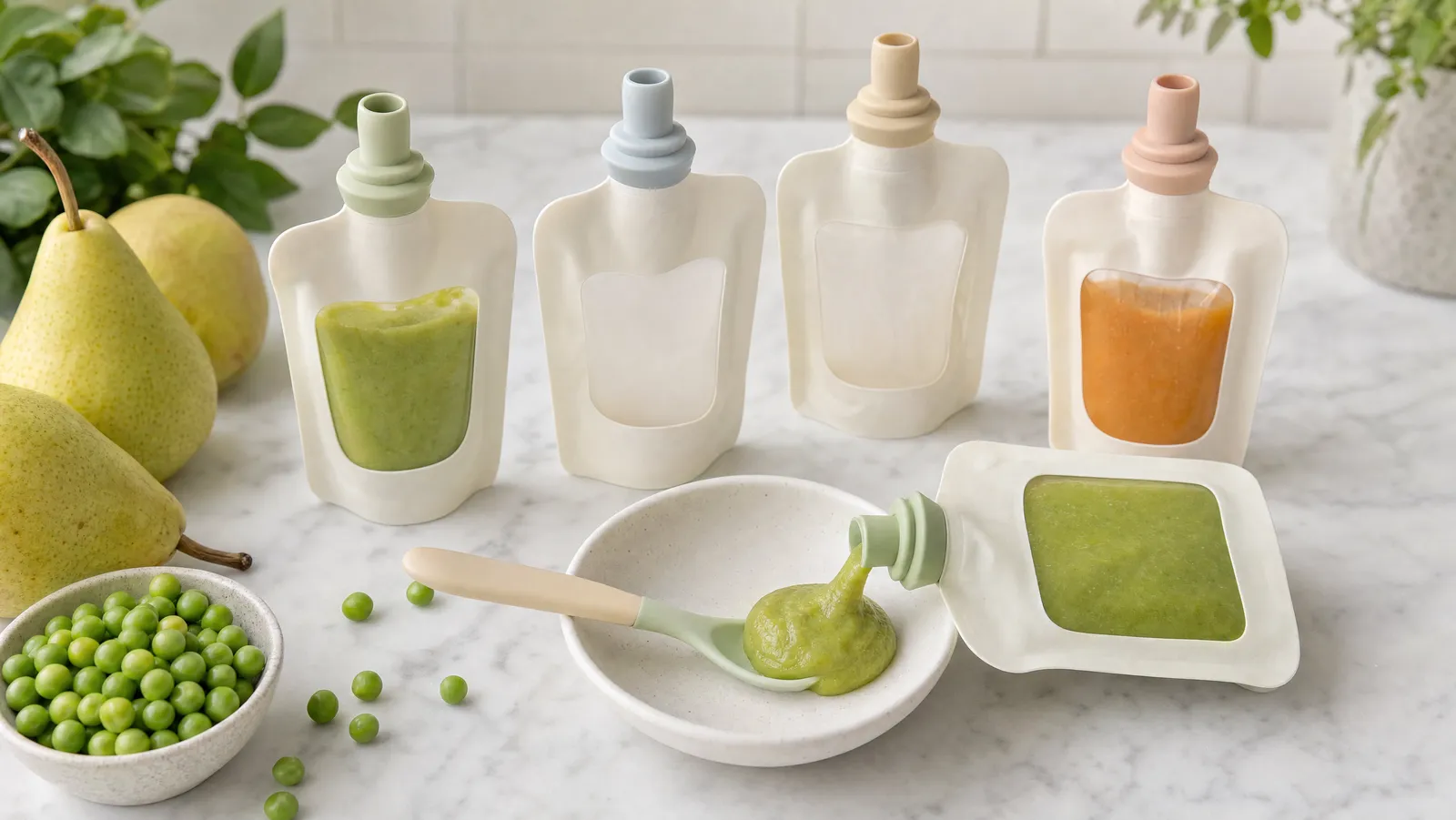
EVLA'S Baby Food Maker — $89.95, the actual one-bowl machine. Water in the tank, food in the bowl, steam, then puree without decanting, with a touch screen for blending speed, temperature and steaming time. Its self-cleaning cycle is the rinse described above, and EVLA'S lists BPA-free food-grade materials and handling of fruits, vegetables and meats. It ships with six reusable pouches, useful if you leave the house — what pouches do well and badly is covered in our look at baby food pouches.
Sunvivi All-in-One — $62.69, the better-value version of the same idea. Sunvivi combines steaming, defrosting, reheating and automatic or manual stirring in one unit, with an LCD touchscreen, a low-water reminder and an auto-cleaning program you fill with water, plus what Sunvivi calls a built-in high-temperature steam cycle that refreshes the cooking chamber between uses — the maker's wording for a rinse. Sunvivi lists FCC, CE, ROHS, CPC and FCM certifications and says it handles fruit, vegetables, meat and fish. One flag: our data describes stirring rather than high-speed blending, so check that if you need a silky first-foods puree.
NutriBullet Baby Complete System — $49.99, and it does not steam. A 200-watt motor base and blade, a 32-ounce batch bowl, a 12-ounce short cup, six storage cups with date-ring lids, a storage tray, a silicone freezer tray and a recipe book, all dishwasher-safe. You cook on the hob and blend in this, which makes it the best-organised storage system here rather than a food maker. If you own a pan, it is a $49.99 blender-and-containers bundle.
Both steam machines hold standing water. Empty, dry and descale the reservoir on the schedule in the manual — a low-water reminder is not a clean-the-tank reminder.
The Blender Route, in Detail
KOIOS 5-in-1 Immersion Blender — $29.99, from $39.99 list. Twelve speeds plus a turbo boost, the feature that matters most for weaning, because the texture you need changes every few weeks. KOIOS lists a 1000-watt all-copper motor with overheat protection and a 304 stainless steel anti-splash shaft, non-BPA and safe for non-stick pots, and it blends straight in the pot — nothing transferred, nothing extra washed. KOIOS advises against running it more than 60 seconds continuously, roughly three times as long as a bowl of steamed carrot needs.
Bonsenkitchen Immersion Blender — $16.99, from $19.99 list. Three hundred watts, two speed buttons, a detachable shaft with dishwasher-safe blades, and that is the whole feature list. Three manufacturer limits, all reasonable: the stick body must never be immersed in water, Bonsenkitchen advises against hard or frozen items without enough liquid, and it recommends pausing every 20 to 30 seconds on tough ingredients. Steamed vegetables trip none of them.
Alimat PluS Silicone Steamer Basket — $11.59, the other half of the setup. A 9.6 by 1.96-inch firm food-grade silicone basket with two 0.98-inch handles, sized for 10 to 11-inch pots and rated from -104F to 446F. The perforation lets steam circulate and drains liquid to the pot bottom — that is the cooking water you blend back in. It protects non-stick coatings a metal insert would scratch, and rolls or hangs instead of claiming a cupboard. Dishwasher-safe, not microwave-safe.
How the Five Setups Compare
| Setup | Steams | Purees | "Self-clean" | Price, Oct 2026 | Use after weaning |
|---|---|---|---|---|---|
| EVLA'S Baby Food Maker | Yes, same bowl | Yes, same bowl | Rinse cycle, per EVLA'S | $89.95 | Little |
| Sunvivi All-in-One | Yes | Stirs, auto or manual | Auto-clean program plus a steam cycle, per Sunvivi | $62.69 | Defrost and reheat small portions |
| NutriBullet Baby System | No | Yes, 200W base | No | $49.99 | Storage cups and freezer tray |
| KOIOS blender + Alimat basket | Yes, on the hob | Yes, 12 speeds plus turbo | No | $41.58 | Soup, smoothies, whisking |
| Bonsenkitchen blender + Alimat basket | Yes, on the hob | Yes, 300W | No | $28.58 | Soup and sauces |
The column that should decide it is the last one.
What You Actually Need Either Way
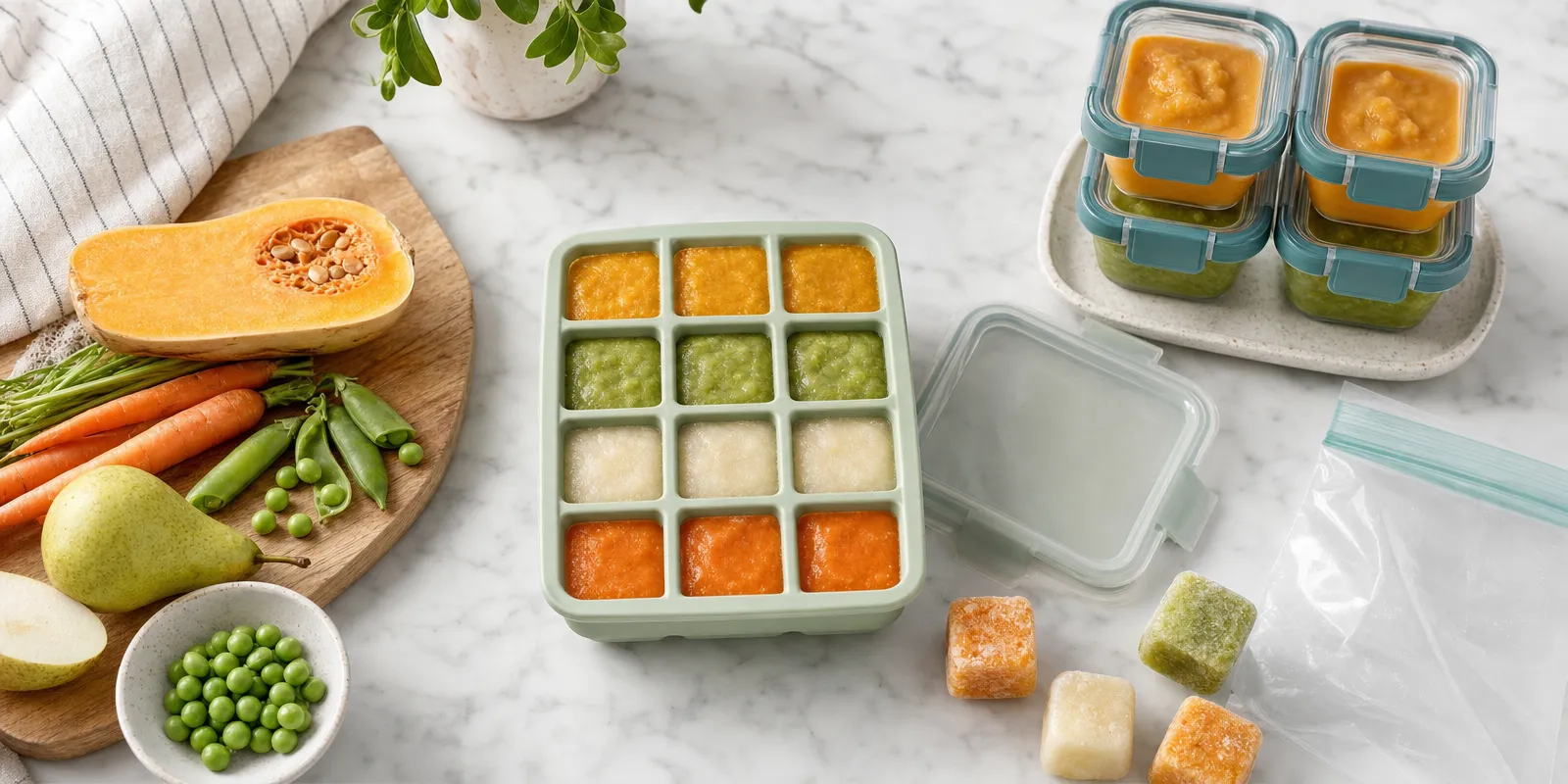
Somewhere to put the food. Batch-cooking without containers is cooking twice, and the storage windows are shorter than most parents assume — our guide to baby food storage containers has the FDA numbers by food type. The FDA's own method is the ice-cube tray: freeze the puree, where one cube equals one serving, then bag and date it, and do not leave baby food out longer than two hours.
A plan for what to cook. Three vegetables and a fruit beats a recipe book you will not open — our shortlist of first foods to offer.
One nitrate note, because you are cooking at home. The AAP's 2005 clinical report on infant methemoglobinemia advises that home-prepared infant foods made from vegetables with naturally occurring nitrates — green beans, carrots, spinach, squash and beets — be avoided before three months of age, because an infant's intake from them can be as high as from well water. Three months, not six, which is less restrictive than the older advice still circulating on forums: if your baby is starting solids at around six months, those vegetables are not off the table.
No sweetener. Purees do not need one, and honey is out: the FDA says honey is not safe for children under a year because it can contain Clostridium botulinum.
Reheating discipline. The FDA says not to microwave baby food in the jar: transfer it to a dish, then always stir, let it stand 30 seconds and taste-test, because microwaved food heats unevenly and the hot spot hides in the middle. No reheat program removes that step.
The Bottom Line
For most families: the Alimat PluS steamer basket at $11.59 plus the Bonsenkitchen immersion blender at $16.99 — $28.58 as of October 2026, for a setup that steams, purees, and then makes soup for a decade. Prefer one good blender to two mediocre ones? The KOIOS 5-in-1 at $29.99 brings the total to $41.58 and adds a chopper and a whisk.
If you are on the buy list — the sink, the hob you cannot stand at, the tiny kitchen with no blender, the Sunday batch — buy the machine without guilt. The EVLA'S at $89.95 genuinely steams and blends in one bowl; the Sunvivi at $62.69 does a version of the job for $27.26 less. The $61.37 you spend over the basket-and-stick setup buys one thing: fewer items in the sink. That is a real thing to buy.
What it does not buy is better food, safer food or a longer puree stage. Those come from variety, from the cooking water blended back in, from a dated cube and a bowl you feed from. If you are earlier in this than an appliance decision suggests, start with our guide to starting solids. The appliance is the smallest decision on the list.

NutriBullet Baby Complete Food-Making System (NBY-50100)
A 200-watt motor base with a blending blade, a 32-ounce (900 ml) batch bowl with a lid, a 12-ounce (355 ml) short cup with handles and a re-sealable lid, six storage cups with date-ring lids, a storage tray, a silicone freezer tray with a lid and a recipe book. One thing to be clear about, because competing roundups get it wrong: this does NOT steam. It blends only, and you cook the food separately on the hob. What you are buying is the best-organised storage system in this guide — the date rings and the freezer tray are the parts that change a Sunday batch-cook. All components are dishwasher-safe, and the batch bowl and cups are BPA-free plastic.
- Brand
- NutriBullet
- Category
- Best Dedicated System
The date-ring lids solve the problem that actually ruins homemade baby food: three bags of identical orange cubes and no idea which Sunday they came from.

EVLA'S Baby Food Maker, Steamer and Blender
The genuine one-bowl machine here: add water to the tank, add ingredients, steam, then puree in the same bowl, with a touch screen for blending speed, temperature and steaming time. EVLA'S describes a self-cleaning cycle in which you add water and a drop of detergent and the machine runs itself — a rinse program, not sterilising, and not a substitute for washing. It ships with six reusable food pouches, is made of BPA-free food-grade materials, and the maker lists it as handling fruits, vegetables and meats.
- Brand
- EVLA'S
- Category
- Best Steam-and-Blend All-in-One
One bowl to wash instead of a pot, a basket, a blender jug and a ladle. If the thing standing between you and homemade food is the sink at 8pm, this is the feature you are paying for.

Sunvivi All-in-One Baby Food Maker and Processor
Sunvivi combines steaming, defrosting, reheating and automatic or manual stirring in one unit, run from an LCD touchscreen with one-touch control. It has an auto-cleaning program you fill with water, a low-water reminder, and what Sunvivi calls a built-in high-temperature steam cycle that refreshes the cooking chamber between uses — the manufacturer's wording, and a rinse rather than sterilisation. Sunvivi lists FCC, CE, ROHS, CPC and FCM certifications and says it works for fruits, vegetables, meat and fish. Note that our source data describes stirring rather than high-speed blending, so check the texture claim against the current listing if you need a silky puree.
- Brand
- SUNVIVI
- Category
- Budget All-in-One
The defrost and reheat programs are the underrated part: if you batch-cook and freeze, the machine you want is the one that can bring a cube back up to temperature without you standing over a pan.

KOIOS 5-in-1 Hand Immersion Blender Set
A five-in-one set that replaces a blender, chopper, whisk, frother and beaker, with 12 speeds plus a turbo boost for texture control — the single most useful feature for weaning, because the texture you need changes every few weeks. KOIOS lists a 1000-watt all-copper motor with overheat protection and a 304 stainless steel anti-splash shaft that is non-BPA and safe for non-stick pots, and it blends directly in the pot or cup with no transferring. Attachments release with one click and are dishwasher-safe apart from the motor. KOIOS advises against running it more than 60 seconds continuously.
- Brand
- KOIOS
- Category
- The Blender Alternative
Blending in the pot is the whole argument against a dedicated machine: nothing gets decanted, so there is no jug to wash, and the same stick makes soup for the next ten years.

Bonsenkitchen Immersion Hand Blender
A 300-watt stick blender with two speed buttons and a detachable shaft whose blades are dishwasher-safe — the cheapest honest route into homemade purees. Three manufacturer limits matter and all three are reasonable: the blender stick body must never be immersed in water, Bonsenkitchen advises against processing hard or frozen items without enough liquid, and it recommends pausing every 20 to 30 seconds on tough ingredients. For steamed vegetables thinned with their cooking water, none of those limits bite.
- Brand
- Bonsenkitchen
- Category
- Cheapest Way In
It is the least impressive object in this guide and it does the entire job. Steam something soft, add a splash of the cooking water, 20 seconds, done.
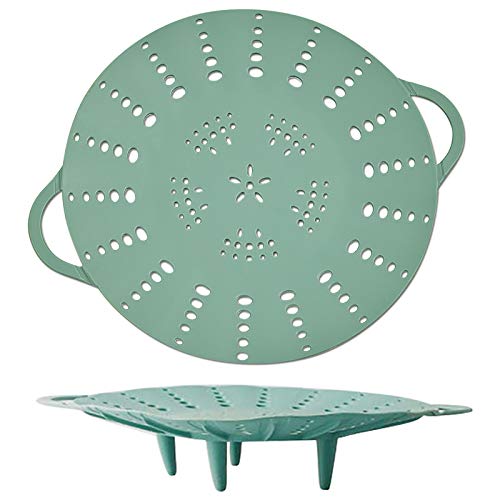
Alimat PluS 9.6-Inch Firm Silicone Steamer Basket
A 9.6 by 1.96-inch firm food-grade silicone basket with two 0.98-inch handles that fits 10 to 11-inch pots, rated from -104F to 446F. The perforated design lets steam circulate and liquid drain to the bottom of the pot, which matters more than it sounds: that drained liquid is the cooking water you blend back into the puree. Silicone protects non-stick coatings where a metal insert scratches them, and the basket rolls or hangs for storage instead of taking up a cupboard. Dishwasher-safe, and not microwave-safe.
- Brand
- Alimat PluS
- Category
- The Other Half of the DIY Setup
It rolls up and hangs on a hook. The dedicated machines it replaces need permanent counter space for about six months of useful life.
- 01NutriBulletBest Dedicated SystemNutriBullet Baby Complete Food-Making System (NBY-50100)
- 02EVLA'SBest Steam-and-Blend All-in-OneEVLA'S Baby Food Maker, Steamer and Blender
- 03SUNVIVIBudget All-in-OneSunvivi All-in-One Baby Food Maker and Processor
- 04KOIOSThe Blender AlternativeKOIOS 5-in-1 Hand Immersion Blender Set
- 05BonsenkitchenCheapest Way InBonsenkitchen Immersion Hand Blender
- 06Alimat PluSThe Other Half of the DIY SetupAlimat PluS 9.6-Inch Firm Silicone Steamer Basket
Is steaming better than boiling for baby food?+
Can I just use a regular blender or food processor to make baby food?+
How long do babies actually need purees?+
Sammie Seelbach
Sammie is a mom of two and the lead reviewer at Smart Baby Reviews. Since becoming a parent she has become obsessed with researching the safest, smartest baby gear on the market — testing thermometers at 2 a.m., wrangling baby gates, and sterilizing more bottles than she can count. She shares what actually works so other parents can make confident, informed decisions for their little ones.